The government tells you what the standard deduction is. You don’t have to claim that standard deduction. You can specifically itemize the deductions you wish the claim instead. You can claim considerably more than the standard, if you so choose.
Whether we should be able to claim more and whether the standard deduction is large enough are different questions.
Overall, the general shape of the system makes sense.
Everybody receives services provided by the government, so everybody should help pay for that government. The FDA tests to make sure food and drugs are safe. The NHTSA makes sure cars and highways are safe. And, of course, the big one, the military protecting the country from invasion. The standard deduction exists so that people only have to start paying taxes once they get their basic needs met.
Of course, I know that in the real world it’s much more complicated than that. The US military might actually make Americans less safe by getting involved in all kinds of conflicts overseas. The terrorist attacks of Sept. 11th would probably never have attacked if the US had a defence-only military. The FDA is being corrupted by an antivax nutjob, and so-on. But, the theory of everybody contributing taxes to pay for things provided for the common good makes sense. The real standard deduction is absurdly low and almost nobody can actually fully meet their needs with that minimal amount.
It also makes sense in the abstract that corporations don’t pay taxes on money that doesn’t get distributed to the owners. If a Mom and Pop grocery store is doing really well and Mom and Pop pay themselves huge salaries, they pay personal income tax on those salaries. If they arrange to do it through corporate dividends or something, then it’s the corporation that pays taxes. On the other hand, if the store is doing really well and they want to expand, it makes sense that the government not tax them based on their revenues if they’re re-investing those revenues into the business. If they’re investing the money into making a bigger, better store to serve their community rather than simply taking the money out as profits into Mom’s purse and Pop’s wallet that’s good for the community. Also, if Mom and Pop made $400k in revenue but spent $390k on expenses, and that includes the wages of some cashiers, it’s probably unreasonable to tax the revenue before the employees are even paid.
The problem is really in the various loopholes and ways corporations claim to be re-investing the money. We wouldn’t want Mom and Pop’s grocery store to be unable to expand because they’re taxed before they can even invest. On the other hand if Pop buys a Porsche SUV under the store’s name and claims it’s a grocery delivery van, that’s not fair. Other people have to buy their SUVs with after-tax money. In theory, if Pop is caught claiming that SUV as a business expense but using it for purely personal purposes, the IRS will go after him. But, of course, the reality is that companies get away with that kind of thing all the time.
I think part of the complaint here is based in the reality that corporations get away with lots of things, and that taxes are a real burden on the poor and middle class. On the other hand, I think there’s also a lot of financial illiteracy where people really have no idea how the taxation system works. They just see ragebait on social media and get angry because something about it seems unfair.
You can claim considerably more than the standard, if you so choose.
You can say that you would like to claim more, but the government sure as hell isn’t going to let you claim survival expenses like that. Go ahead and try to claim your rent. Unless you are using part of your rental for business purposes (not just living) they’ll just tell you to get fucked and pay the taxes anyway.
So yes, you can put it on the paperwork. But actually claim it? Almost certainly not.
It certainly depends on what you’re actually paying, yes. It’s very unlikely that your deductible expenses will be greater than the standard deduction. But, it is certainly possible under certain (rare) conditions.
Rent alone here is higher than the basic personal amount, let alone any other necessities. And I’m in one of the cheapest cities in Canada for rental housing.
Which is to say, almost every single tax paying person in the entire country would be getting more than the basic personal amount (Canada’s version of the standard deduction in the US) if we were allowed to claim basic necessities. And not by a small amount.
All you are telling me is that “rent” isn’t a deductible expense.
None of that changes the fact that if you have more deductible expenses than the standard deduction, you can claim greater than the standard deduction.
The standard deduction is ~$16,000 for a single person. Medical expenses are deductible. If they spend $32,000 in a hospital stay, they would be better off itemizing the whole deduction rather than taking only the standard deduction.
Of course, they aren’t obligated to itemize. They could just take the standard deduction and be done with it. That choice is available to them, foolish as it is.
Educational expenses are deductible. They can choose to spend much more than $16000 on school expenses, claiming much more than the standard deduction.
Again, what should and should not qualify as deductible, and the size of the standard deduction are completely separate questions.
We’re literally talking about corporations being “people” but able to deduct things that people can’t. If corporations are people, and they can deduct rent (they can) why can’t everyone else.
You’ve completely lost the plot mate. You can’t say THE LITERAL QUESTION WE ARE TALKING ABOUT is a separate question, wtf lol
A large part of my house is used exclusively for business purposes. I deduct that part.
I don’t do this myself, but businesses are allowed to compensate workers with, in part, housing. Your home-based business could deduct the housing it provides to workers, including yourself.
None of that changes the fact that if you have more deductible expenses than the standard deduction, you can claim greater than the standard deduction.
You are missing the point that for a business everything is a deduction and for an individual almost nothing counts as an itemized deduction.
It is a lie to say “you could itemize” when the IRS specifically does not allow W2 employees to itemize rent, transportation, food, and entertainment.
It is a lie to say “you could itemize” when the IRS specifically does not allow W2 employees to itemize rent, transportation, food, and entertainment.
You’re getting hung up on the categories. You don’t have to be just a W2 worker for someone else’s business. You can also be a contractor: you can be a business yourself. No, you can’t deduct that part of your subsistence you use for W2 employment or personal use. But, you can put yourself on the clock for your own business, and that business can deduct everything that any other business can do.
If you’re not deducting that part of your home, utilities, vehicles, electronics, tools, and equipment that you use for various business purposes, you’re doing something very wrong.
Your business doesn’t have to actually turn a profit. Legally, you have to try to turn some kind of profit, but you don’t have to actually succeed. 30% of home-based businesses never do.
“If you’re not deducting that part of your home, utilities, vehicles, electronics, tools, and equipment that you use for various business purposes, you’re doing something very wrong.”
Ok, but why should it have to be for business purposes to be deductible? Why does a landlord get to deduct the same exact expenses a private homeowner cannot?
I haven’t addressed that issue. I’ve addressed the fairness issue. If you can present your expenses as business expenses, you should. If the only reason you can’t is because you aren’t presenting yourself as a business, present yourself as a business and take the deductions.
That’s the OP argument! You can’t say, employee taxes aren’t unfair, just be an employer. It’s ridiculous! You have only restated the OP’s claim: businesses can deduct virtually everything and employees can deduct virtually nothing.
Forget about all of your W2 earnings for a moment. Forget about the 8.5 hours a day you spend working for someone else. Forget about your bi-weekly paycheck. None of that stuff matters here, or to the IRS.
Forget all of that, hold an annual garage sale.
Now, you’re a business. You get to deduct the poster board you purchase advertising your sale. You get to deduct the balloons and price stickers.
You also get to deduct that part of your rent or mortgage that you spend on the garage where you keep your inventory. That is now your “warehouse”, which is part of your (non-employment) business. How about your attic? The attic is part of your home. You pay mortgage/rent/taxes on that part of your home right along with every other part. I doubt you use it for anything but storage anyway. Put the crap in your attic on your lawn with a price tag once a year, and you get to deduct the part of your housing payment that goes toward your attic.
You get to deduct the cost of acquiring your inventory. That is also a business expense.
Spend an afternoon in a lawnchair while your neighbors look through your junkinventory, and you get to claim thousands of dollars in business expenses.
If you’re worried the IRS might take issue with you if you only do this once a year, you can put up an ebay, etsy, craigslist, or marketplace listing, and it becomes a year-round operation. You are now an online retailer, and your annual garage sale is just a clearance sale for that business. If you’re still not sure, you can file paperwork with the state to be able to collect sales tax (and deduct the filing fee as a business expense).
You can’t say, employee taxes aren’t unfair, just be an employer. It’s ridiculous!
I absolutely can, and it’s not ridiculous at all. The problem you’re having here is that you think you need to be Walmart in order to call yourself a business. You don’t. You think you need to generate a profit to be a business. You don’t. (You do need to try to generate a profit. But, very few businesses are actually able to successfully generate a profit, and yours doesn’t need to be successful either. “Trying” is enough.) I am quite confident that many of the things you do in your day-to-day life can already be categorized as “business”, or could be considered a business with slight tweaks. You are legally entitled to count expenditures on those activities as deductible business expenses.


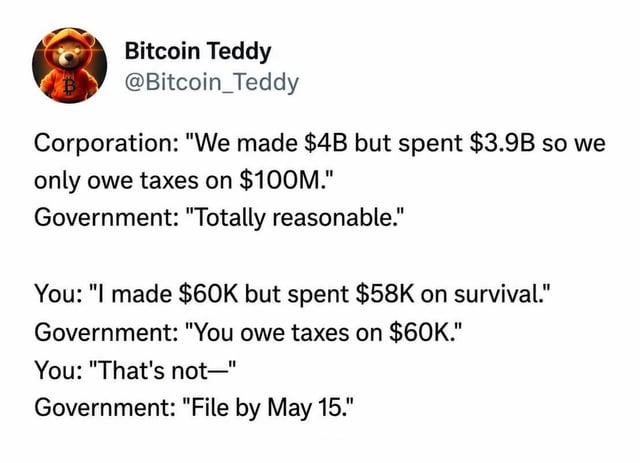
The government tells you what the standard deduction is. You don’t have to claim that standard deduction. You can specifically itemize the deductions you wish the claim instead. You can claim considerably more than the standard, if you so choose.
Whether we should be able to claim more and whether the standard deduction is large enough are different questions.
Overall, the general shape of the system makes sense.
Everybody receives services provided by the government, so everybody should help pay for that government. The FDA tests to make sure food and drugs are safe. The NHTSA makes sure cars and highways are safe. And, of course, the big one, the military protecting the country from invasion. The standard deduction exists so that people only have to start paying taxes once they get their basic needs met.
Of course, I know that in the real world it’s much more complicated than that. The US military might actually make Americans less safe by getting involved in all kinds of conflicts overseas. The terrorist attacks of Sept. 11th would probably never have attacked if the US had a defence-only military. The FDA is being corrupted by an antivax nutjob, and so-on. But, the theory of everybody contributing taxes to pay for things provided for the common good makes sense. The real standard deduction is absurdly low and almost nobody can actually fully meet their needs with that minimal amount.
It also makes sense in the abstract that corporations don’t pay taxes on money that doesn’t get distributed to the owners. If a Mom and Pop grocery store is doing really well and Mom and Pop pay themselves huge salaries, they pay personal income tax on those salaries. If they arrange to do it through corporate dividends or something, then it’s the corporation that pays taxes. On the other hand, if the store is doing really well and they want to expand, it makes sense that the government not tax them based on their revenues if they’re re-investing those revenues into the business. If they’re investing the money into making a bigger, better store to serve their community rather than simply taking the money out as profits into Mom’s purse and Pop’s wallet that’s good for the community. Also, if Mom and Pop made $400k in revenue but spent $390k on expenses, and that includes the wages of some cashiers, it’s probably unreasonable to tax the revenue before the employees are even paid.
The problem is really in the various loopholes and ways corporations claim to be re-investing the money. We wouldn’t want Mom and Pop’s grocery store to be unable to expand because they’re taxed before they can even invest. On the other hand if Pop buys a Porsche SUV under the store’s name and claims it’s a grocery delivery van, that’s not fair. Other people have to buy their SUVs with after-tax money. In theory, if Pop is caught claiming that SUV as a business expense but using it for purely personal purposes, the IRS will go after him. But, of course, the reality is that companies get away with that kind of thing all the time.
I think part of the complaint here is based in the reality that corporations get away with lots of things, and that taxes are a real burden on the poor and middle class. On the other hand, I think there’s also a lot of financial illiteracy where people really have no idea how the taxation system works. They just see ragebait on social media and get angry because something about it seems unfair.
You can say that you would like to claim more, but the government sure as hell isn’t going to let you claim survival expenses like that. Go ahead and try to claim your rent. Unless you are using part of your rental for business purposes (not just living) they’ll just tell you to get fucked and pay the taxes anyway.
So yes, you can put it on the paperwork. But actually claim it? Almost certainly not.
It certainly depends on what you’re actually paying, yes. It’s very unlikely that your deductible expenses will be greater than the standard deduction. But, it is certainly possible under certain (rare) conditions.
Rent alone here is higher than the basic personal amount, let alone any other necessities. And I’m in one of the cheapest cities in Canada for rental housing.
Which is to say, almost every single tax paying person in the entire country would be getting more than the basic personal amount (Canada’s version of the standard deduction in the US) if we were allowed to claim basic necessities. And not by a small amount.
All you are telling me is that “rent” isn’t a deductible expense.
None of that changes the fact that if you have more deductible expenses than the standard deduction, you can claim greater than the standard deduction.
The standard deduction is ~$16,000 for a single person. Medical expenses are deductible. If they spend $32,000 in a hospital stay, they would be better off itemizing the whole deduction rather than taking only the standard deduction.
Of course, they aren’t obligated to itemize. They could just take the standard deduction and be done with it. That choice is available to them, foolish as it is.
Educational expenses are deductible. They can choose to spend much more than $16000 on school expenses, claiming much more than the standard deduction.
Again, what should and should not qualify as deductible, and the size of the standard deduction are completely separate questions.
We’re literally talking about corporations being “people” but able to deduct things that people can’t. If corporations are people, and they can deduct rent (they can) why can’t everyone else.
You’ve completely lost the plot mate. You can’t say THE LITERAL QUESTION WE ARE TALKING ABOUT is a separate question, wtf lol
A large part of my house is used exclusively for business purposes. I deduct that part.
I don’t do this myself, but businesses are allowed to compensate workers with, in part, housing. Your home-based business could deduct the housing it provides to workers, including yourself.
You are missing the point that for a business everything is a deduction and for an individual almost nothing counts as an itemized deduction.
It is a lie to say “you could itemize” when the IRS specifically does not allow W2 employees to itemize rent, transportation, food, and entertainment.
You’re getting hung up on the categories. You don’t have to be just a W2 worker for someone else’s business. You can also be a contractor: you can be a business yourself. No, you can’t deduct that part of your subsistence you use for W2 employment or personal use. But, you can put yourself on the clock for your own business, and that business can deduct everything that any other business can do.
If you’re not deducting that part of your home, utilities, vehicles, electronics, tools, and equipment that you use for various business purposes, you’re doing something very wrong.
Your business doesn’t have to actually turn a profit. Legally, you have to try to turn some kind of profit, but you don’t have to actually succeed. 30% of home-based businesses never do.
“If you’re not deducting that part of your home, utilities, vehicles, electronics, tools, and equipment that you use for various business purposes, you’re doing something very wrong.”
Ok, but why should it have to be for business purposes to be deductible? Why does a landlord get to deduct the same exact expenses a private homeowner cannot?
I haven’t addressed that issue. I’ve addressed the fairness issue. If you can present your expenses as business expenses, you should. If the only reason you can’t is because you aren’t presenting yourself as a business, present yourself as a business and take the deductions.
That’s the OP argument! You can’t say, employee taxes aren’t unfair, just be an employer. It’s ridiculous! You have only restated the OP’s claim: businesses can deduct virtually everything and employees can deduct virtually nothing.
Sigh.
Forget about all of your W2 earnings for a moment. Forget about the 8.5 hours a day you spend working for someone else. Forget about your bi-weekly paycheck. None of that stuff matters here, or to the IRS.
Forget all of that, hold an annual garage sale.
Now, you’re a business. You get to deduct the poster board you purchase advertising your sale. You get to deduct the balloons and price stickers.
You also get to deduct that part of your rent or mortgage that you spend on the garage where you keep your inventory. That is now your “warehouse”, which is part of your (non-employment) business. How about your attic? The attic is part of your home. You pay mortgage/rent/taxes on that part of your home right along with every other part. I doubt you use it for anything but storage anyway. Put the crap in your attic on your lawn with a price tag once a year, and you get to deduct the part of your housing payment that goes toward your attic.
You get to deduct the cost of acquiring your inventory. That is also a business expense.
Spend an afternoon in a lawnchair while your neighbors look through your
junkinventory, and you get to claim thousands of dollars in business expenses.If you’re worried the IRS might take issue with you if you only do this once a year, you can put up an ebay, etsy, craigslist, or marketplace listing, and it becomes a year-round operation. You are now an online retailer, and your annual garage sale is just a clearance sale for that business. If you’re still not sure, you can file paperwork with the state to be able to collect sales tax (and deduct the filing fee as a business expense).
I absolutely can, and it’s not ridiculous at all. The problem you’re having here is that you think you need to be Walmart in order to call yourself a business. You don’t. You think you need to generate a profit to be a business. You don’t. (You do need to try to generate a profit. But, very few businesses are actually able to successfully generate a profit, and yours doesn’t need to be successful either. “Trying” is enough.) I am quite confident that many of the things you do in your day-to-day life can already be categorized as “business”, or could be considered a business with slight tweaks. You are legally entitled to count expenditures on those activities as deductible business expenses.