

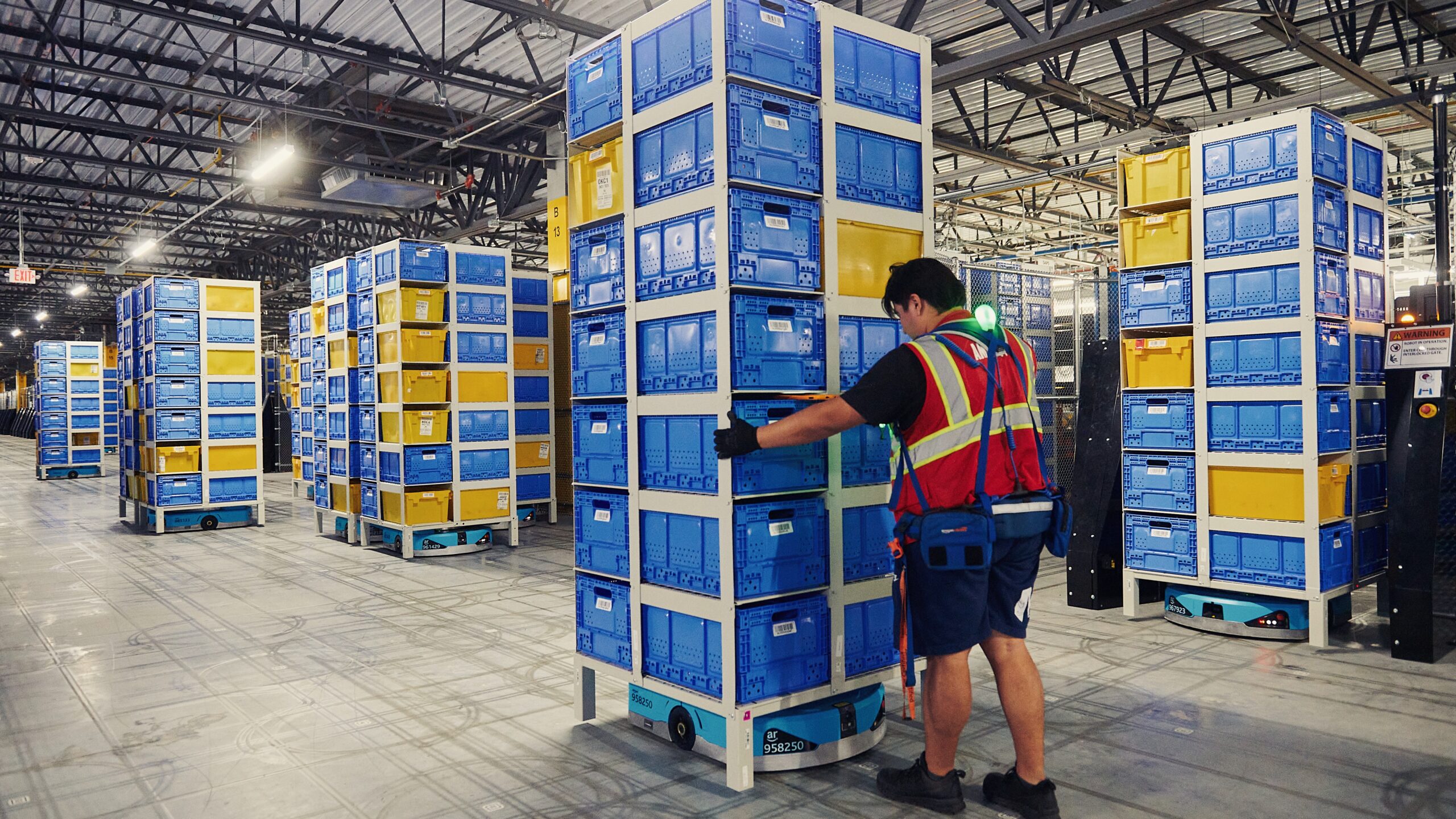
The most nuanced findings on Amazon’s automation drive may come from a research study published in the journal ILR Review in April 2025. That analysis showed Amazon’s robotic warehouses had a 40 percent decrease in severe injuries compared to legacy fulfillment centers—which suggests some benefits from having robots take on the most physically challenging and risky tasks.
However, the same study also found that robotic fulfillment centers had a 77 percent increase in less severe injuries associated with physical strain from repetitive motions.
“At least one of the mechanisms by which this appears to be manifesting is through the pace of work, in that pick rates for the robotic fulfillment centers are off the charts higher,” said Greenwood at George Mason University, who was one of the paper’s coauthors.
A faster pace of work driven by partial automation could mean “the robot is dictating the pace of work” and spurring human employees to perform certain repetitive actions more quickly, Greenwood told Ars. “That appears to be what’s driving the strains and the sprains that we observe,” he said.
Optimizing getting the most out of human bodies before they fall completel apart!
Automation is NOT an issue, by that logic we should all be outside tending fields and crops
I don’t expect that evolution to come from the (current) US culture, but what we all need to invent, especially here on slrpnk.net, is a post-labor society. Consumption and desire-driven, constrained more by ressources usage than by labor costs.
Depending on how fast we imagine it as an utopia, we lower it chances to become a neo-feudeal dystopia.
How much that people buy is really necessary? Reducing demand also reduces labour requirement. We could probably be most of the way there today just by changing what we value.
Yes. One way to reach post-scarcity is to organize to need less.
It’s baked in our DNA. Those with more resources reproduced more.
Greed won’t just disappear.
Consumption and desire-driven, constrained more by ressources usage than by labor costs.
Have you looked around? Capitalism is creating desire and fueling consumption wherever it can. We are limited by resource usage and seeing the consequences of it. Going all in on an consumption- and especially desire-driven economy sounds horrible. That’s definitely not the solarpunk way. Or if it is, I’m in the wrong place.
I do tend to differentiate artificially engineered desires and real ones.
We are not being limited by resources usage in any tangible way before it is too late. Fuel will be affordable until it becomes basically unavailable. Our only current rationing mechanism right now is market prices.
And I don’t know about you, but labor cost in my branch is the main constraint telling how much I get paid and how much I can afford.
If you differentiate engineered desires and “real” ones then “need” might be a better word.
And there are different aspects of being limited by resources, not just financial cost. One of the reasons we have all the ecological problems right now is because we ignore the environmental impacts of our resource usage. Your fuel example is on point - oil and gas are still way too cheap compared to the damage they do to the environment. So when we follow your proposal of trying to form a society that aims to be constrained by resources, then I’d say we are already there. We couldn’t have done much better. It’s just not being constrained by availability, but by the consequences of our usage.
However, there are even a few examples where we are starting to be constrained by actual resource availability, from the top of my head sand for concrete and copper come up.
I hope the idea of solarpunk is trying to keep the planet in a livable state.
