There really aren’t that many modem/router combos out there you can actually flash with open source firmware.
Router? Sure, no problem.
Modem? Outside of some very niche Fritzbox devices and others listed on OpenWRT Table of Hardware

There really just aren’t that many.
So, fine. I will use a proprietary modem.
I will put it into bridge mode, let it decode the DSL analog signals into ethernet and feed that into a router of my choice.
Question is: Which modem?
I don’t want two devices heating up my shelf. I just want a tiny modem that converts analog to digital into an RJ45 and then let’s the router do its thing.
Does such a magical device exist, because my search on this front has proved largely fruitless
Honestly, I’d just use whatever the ISP provides.
Sure, it’s not open source and it kinda sucks… But I mean, if you don’t trust the ISP modem, you can’t trust the rest of their infrastructure either anyway, so it’s kinda moot.
At least that way you have a vague chance of having a modicum of support when shit breaks.If it can’t be put into bridge mode, it probably has some sort of DMZ function where it basically does port forwarding for any/all possible ports.
Double NAT isn’t as bad as it sounds these days.Now to your question…
They exist, they’re mostly targeted at ISPs though, so might be a harder find than other things.
They might also be older, as basically all customers also want their ISP to provide Wi-Fi, which a bridge modem won’t.
Anyway,
You’ll have to know what DSL were talking about, there’s… ADSL, ADSL2+, VDSL, VDSL2, etcOne old-ass model we used to use back in the day was… a Siemens 5200, but that’s ADSL2 at best, definitely not VDSL.
Siemens 5200
That’s a chunky house warmer, let alone shelf warmer!
I can understand that ISP’s need to protect their security (through obscurity) so that no one’s going around cloning their neighbors analog signals to score free internet… but surely the actual hardware to do the tone pairing / channel matching analog-to-digital-magic-mumbo-jumbo does not need to be the size of a brick?
In the spirit of people cutting open Nintendo Wii’s shearing down the chip and making compact versions[0], has no one isolated the hardware on a modem, chucked out the routing stuff, and compacted the whole device to be no bigger than a USB stick?
The fibre modem my ISP uses is pretty small, about the same size as one of those small unifi switches, but it still feels like there’s almost nothing in it.
I have taken apart the fibre modem of a different provider before, which was just a small PCB no larger than a raspberry pi and a fibre extension cable.
It was packed in this hunk of junk.
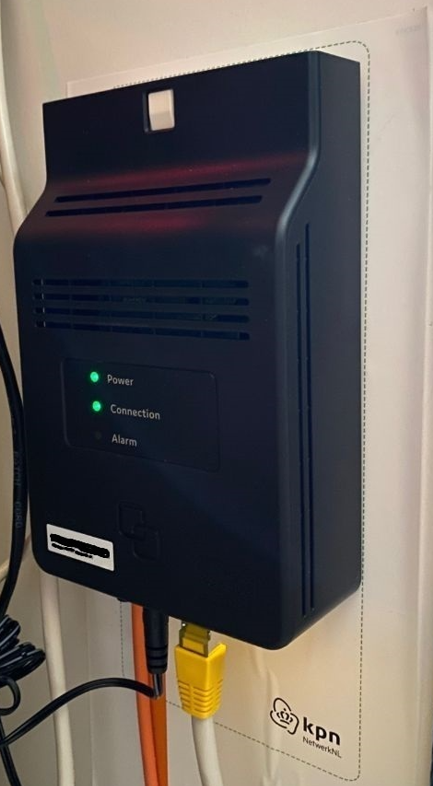
Hmm! Good to know there’s some hope with the size of fibre modems
I’m mad you started your citation at 0.
I’m telling Chicago style!
Is this how one prevents viruses?? 😂
it’s how I sanitize all my inputs from unknown devices :-)
Not quite what you’re seeking, but maybe relevant.
Have you considered an SFP modem like the Proscend 180T? Might be hard to source these days, but if you have a router with an SFP cage this would be a way to accomplish the single box goal.
Woah… I had never heard of SFP slots/devices before. It looks like they’re great at converting between mediums. If I could get an SFP device that had RJ45 output, that would be the dream
Maybe you could use a Mikrotik RouterBOARD, some feature a single SFP port. They’re great and inexpensive.
If by RJ45 you mean erhernet over standard 8P8C (i.e. RJ45) your looking for SFP-T modules. Can’t connect that to your DSL line though since that’s not Ethernet.
There do seem to exist G.fast sfp modules for dsl, but do note that sadly sfp module and router brand incompatibility is sadly a thing.
Related note: At our company we also had quite some issues getting some of these more special sfp modules working (e.g. XGS-PON), so ymmv with a dsl one.
(If you’re looking for a device to plug sfp modules into, I can second MikroTik here. They’re also great about accepting 3rd party SFPs)
Not sure if they’re still in production. There was also an Italian company selling one (maybe based on the same hardware).
Like u/floquant I would look at Mikrotik. But you’ll need to pay attention to port speed (they still sell 100Mbps gear) and their tested routing throughput numbers to be sure they can hit the numbers you need.
Is there any reason you are not just calling your ISP and asking them to put their box into bridge mode and then setting your own router up behind it?
You control everything from the router and into your local network.
If you can’t trust your ISPs “modem” in bridge mode, then you also can’t trust the infrastructure beyond the modem, and in that case you would need to set up a privacy respecting VPN service directly on your router to encrypt the traffic your ISP sees.
Netgear DM200? Supports openwrt to if you really want. You’ll have to buy used now though.
If your dsl is G.Fast you could try the Zyxel GM4100. That device is only a bridge
I would start with your ISP’s list of supported devices.
I do, they’re all TP-Link devices which is a company that makes solid solid hardware, but they have sketchy links to foreign state cyber attacks[0]. I don’t mind having a dumb switch from TP-Link that I can just network devices together locally and forbid it from having internet access via the router.
The so called investigation is political
TP-Link isn’t perfect but they have decent security practices. (Unlike Cisco, Forinet and many other “premium” vendors)
I would use OpenWRT
Also, could you get fiber? A DSL connection in 2025 is going to be pretty slow.