

- cross-posted to:
- world@quokk.au
- cross-posted to:
- world@quokk.au
cross-posted from: https://lemmy.sdf.org/post/55562277
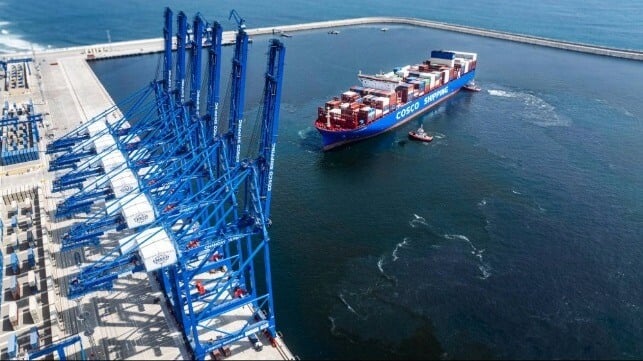
Chancay was built to be Beijing’s flagship gateway into South America. A Lima court ruling has just put it back under Peruvian state oversight.
[…]
China’s flagship South American port in Peru’s Chancay [located approximately 50 miles north of Lima, Peru] is back under state oversight.
[…]
On July 1, the Second Constitutional Chamber of the Superior Court of Lima overturned a January ruling that had stripped Ositrán, Peru’s transport infrastructure regulator, of its power to inspect and sanction the $1.3bn Megaport of Chancay. For a facility built to be China’s main gateway into South America, this is a serious reversal.
The ruling landed days after a separate court blocked a parallel attempt by the port’s operator, Chinese state-controlled Cosco Shipping, to halt an antitrust probe by Indecopi, Peru’s competition authority. Together, the two rulings end Cosco’s brief run of regulatory immunity. The court’s reasoning was blunt: Chancay is a public-use facility, regardless of the private ownership structure behind it.
[…]
Peru has been under pressure from the United States since the port opened. American lawmakers argued Chancay has “dual useage” potential and that it could become a “direct military threat to the western hemisphere.” Chinese officials have pushed back on these accusations as they have with the Panama Canal assertions.
[…]
On appeal by the state’s regulatory authority, Ositran, a court in Peru ruled yesterday that the state has an oversight authority because the port, while privately built and operated, is a public-use port. It said Ositran has the authority to regulate, supervise, inspect, and sanction operators under Peruvian law.
[…]
The new decision is not final and can still be appealed in the courts.
[…]
Bilateral, mutually beneficial trade deals are one thing (Chile should of course ensure that such trade deals are fair and equitable, but that process should not be influenced by American geopolitical concerns); China taking steps to unilaterally seize control of democratic Taiwan and territory and waters in the South China Sea that maritime law clearly states as belonging to its neighbors is something entirely different.
It’s important to recognize China’s trade deals in the context of how they engage in geopolitics, but the U.S. actively intervening in those trade deals is a form of neo-colonialism. There are better ways to prevent China from economically exploiting countries in the global south.
And the context is China looking to gain global hegemony.
Don’t get me wrong the trade deal is in the up and up, but let’s not pretend these belt and road deals are just looking to make money and nothing else
Of course; China’s claim to being the defender of the global south against neo-colonialism is a form of neo-colonialism itself.
In this case yes, did you seriously think China was being totally on the up and up?