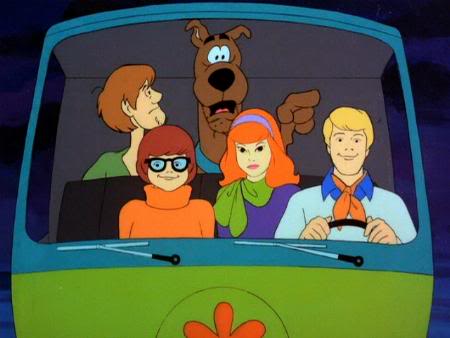
A friend and I are arguing over ghosts.
I think it’s akin to astrology, homeopathy and palm reading. He says there’s “convincing “ evidence for its existence. He also took up company time to make a meme to illustrate our relative positions. (See image)
(To be fair, I’m also on the clock right now)
What do you think?
Science has never in the history of science reliably shown a single interaction between physical entities and any sort of non-physical force. The only way ghosts could be real is if you redefined the term “ghost” to the point of breaking, like saying that the memory of a person is a ghost.
Plus, it fails the smell test in a million ways. What makes a ghost exist? Why aren’t we positively lousy with ghosts? Are there rules? What would they be and what mechanism is there to both quantify and effect them? Why do ghosts follow the rotation and revolution of the earth but otherwise aren’t physically bound? How can one have any sort of cognition? If a ghost does, how can it perceive anything without intercepting photons or other physical phenomena? If there are ghosts and somehow they have cognition and perception, are we obligated to leave Netflix on when we leave for work?
Technically, the moment science would show an interaction between physical entities and something else, that something else would immediately be classified as a physical entity. In a very real sense, the discovery of radioactivity involved physical entities being found to interact with an as-yet unknown, invisible, intangible force.
If ghosts existed, the same would happen as with radioactivity. They would be researched, hypotheses on their nature would be tested, and a scientific theory would arise, and then they would be a part of the “physical world” too. And then all the mystics would be bored with ghosts because they are just incorporeal noospheric echoes of old people, as boring as neurology or biochemistry or stellar fusion.
If a bunch of people were going around saying I got this weird burn on my skin after holding this rock for a while, scientists would have discovered radioactivity a lot sooner.
There are a bunch of people going around claiming to have interacted with ghosts, and we’ve got bupkis.
That reminds me of this meme:

I found it here after an internet search trying to find it again, but I’m not sure if it is the original source:
https://www.reddit.com/r/Cryptozoology/comments/1c7btq9/ill_just_leave_this_here/
The indigenous Australians, the Mirarr people, identified an area in Northern Australia as sickness country which was very coincident with a high concentration of uranium.
They just avoided the area instead of poking it
https://d28rz98at9flks.cloudfront.net/145214/145214_00_0.pdf
Aw man. The northern tip of Australia has the cleanest air in the entire world. That data is from pre-y2k
Not sure about that, you might be thinking of the Southern tip. Indonesia often conducts burn offs with a lot of wind blowing smoke over Australia as well as cultural burning conducted by the indigenous in the region. I remember seeing the haze growing up and walking through the burnt country at the start of the dry.
Science has never in the history of science reliably shown a single interaction between physical entities and any sort of non-physical force.
Fucking magnets,
How do they work?
Magnetism is a physical force, like gravity. Measurable and consistent.
You keep saying “physical force”…
That’s not a real term in physics.
The only possible explanation, is you mean any force that is already explained by physics, is that what you mean?
Because that would be the same as insisting we know everything, which no one who knows anything about physics would ever try to claim.
So…
What exactly do you mean when you keep saying “physical forces”?
One of the definitions of “physical” in the American Heritage Dictionary is:
Of or relating to matter and energy or the sciences dealing with them, especially physics.
I mean there’s no way to go from immeasurable to measurable except in scale, and anywhere north of quantum scale, physics has been reliably predictable and measurable. Ghosts’ purported impact is on a scale well above that which is unexplained.
Why do you say ghosts’ purported impact is on a scale above that which is unexplained?
Quantum fields impact the universe on a scale above their own. It’s entirely possible that the explanation for ghosts is on the quantum scale or smaller, and the observable effects are just that: effects of a much subtler phenomenon.
Yes, quantum scale has macro effect, but the macro scale is predictable and rigidly causal, negating any meaningful quantum scale interactional impact. A macro causation effected via quantum interactions is a de facto macro interaction.
None of what you’ve said is n this thread makes any logical sense…
Which would be fine cuz it’s about ghosts, but you keep acting like physics backs up your wild statements and made up vocabulary…
What vocabulary did they make up?
I’m not making shit up as I go. If you don’t understand something, it isn’t consequently nonsensical.
https://en.wikipedia.org/wiki/Interactionism_(philosophy_of_mind)#Problem_of_causal_interaction
What exactly do you mean when you keep saying “physical forces”?
The phrase doesn’t appear once in your link. Or anywhere else in reference to physics…
You 100% made that up, and at this point I don’t really care why
and consistent
Nope.
Explain please?
The earth’s magnetic field is fluid and changing, magnetism is affected by electrical current or heat.
I don’t mean that any given magnetic field is unchanging, I mean that the principles are stable and well-understood. We never see magnetic fields just randomly change with no reason or else navigation and all kinds of other technologies would be fucked forever.
I think you could rationally explore ghosts in the “radically redefining” them arena. Ghosts could rationally exist as an artifact of your mind, and saying that is not the same thing as saying they don’t exist. Hallucinations exist. They aren’t real, but they exist. Ghosts could rationally exist in the exactly same way, as processes in our own heads. It’s when you start saying they interact with the world in a way outside people’s heads that you can’t really reconcile.
Except that’s not what we mean when we talk about ghosts. Ghosts are meant to be actual beings with an actual existence, if very different from living beings.
The concept of ghosts exist (as does for all things for which we have words). Some people do believe ghosts exists, and some might have seen ghosts (just like someone actually sees a hallucination). All this doesn’t mean ghosts exist, or else the actual concept of non-existence doesn’t exist - which makes the fallacy evident: if we are to consider that all concepts actually exist (further than just an idea), non-existence has to exist.
Saying “science has never reliably shown something” is not the same as “science has definitively proven something false.” Claiming otherwise is anti-scientific and logically fallacious.
According to the scientific worldview, we don’t know what we don’t know until we know it. Otherwise, we would never discover anything new.
I’m not saying ghosts are real. I’m just encouraging a healthy skepticism, whether for or against. So I’ll play devil’s advocate and respond in turn to each of your “million ways” it fails the smell test.
What makes a ghost exist?
We don’t know, but there’s a lot we don’t know. What makes gravity exist? What made matter and energy exist? What causes the big bang? What is the origin and nature of dark matter?
There’s a lot we don’t understand about the universe, so the answer could be as simple as a cloud of electrons or even photons, or as complex as a field of quantum fluctuations, dark matter, a previously undiscovered type of boson, a state of matter beyond plasma where the particles vibrate so rapidly that they’re mostly unobservable, a range of electromagnetic frequencies with wavelengths so fine that our instruments can’t detect them, or even an entity in a higher dimension that ephemerally crosses the plane of our familiar third dimension.
Why aren’t we positively lousy with ghosts?
The answer depends on the above, but it could be that we are and just can’t observe them under ordinary circumstances. Or perhaps there’s a different place where they go, or possibly a different dimension, and we only notice the ones who get stuck here somehow. Or perhaps there’s some sort of ethereal ecosystem which keeps the ghost population in check like birds do for insects.
Are there rules?
Probably, but there are plenty of rules in the universe we don’t understand. What rule is responsible for gravity? Why does dark matter behave the way it does? Why do quantum fluctuations behave the way they do? Why does spacetime behave the way it does? And why do quantum mechanics and general relativity seem to describe contradictory sets of rules for the same universe, albeit at different scales relative to the one at which newtonian physics are accurate?
Until we figure out unified field theory, dark matter, and that higher dimension thing, we can’t pretend we’ve described every rule in the universe.
What would they be and what mechanism is there to both quantify and effect them?
This has already been addressed under “what makes them exist?”
Why do ghosts follow the rotation and revolution of the earth but otherwise aren’t physically bound?
It could be that their physically-boundedness is just subtler than most things we’ve observed. They could maintain their relative position gravitationally or by friction, or possibly through electromagnetism, quantum entanglement, exertion of conscious effort, or simply some higher-dimensionality which allows them to be present anywhere they want at a given moment.
How can one have any sort of cognition?
How can any living human have any sort of cognition? There’s a lot we don’t understand there either. It could be that consciousness is a property of electromagnetic fields, in which case it would explain it if the ghosts were made of electron clouds. Or perhaps consciousness is a property of quantum fields, or something else we don’t understand such as a higher-dimensional entity with more complex states of matter and energy, that simply can only perceive and interact with the world in three dimensions because those are the limitations of the physical organism it has developed to inhabit and maintain itself.
So the answer to ghost cognition depends on the answer to human consciousness, which is still one of the major mysteries of the universe.
Alternatively, perhaps ghosts aren’t conscious at all and only appear to be, but they’re really more like a complex sort of jellyfish, mindlessly following patterns that were set by the mind of the conscious entity prior to the death of the physical organism.
If a ghost does, how can it perceive anything without intercepting photons or other physical phenomena?
Perhaps it directly perceives electromagnetic waves that enter its field of existence, or perhaps there’s some higher-dimensional perspective that allows them to observe the 3-dimensional world from the outside.
We don’t intercept photons when we dream, yet our brains construct images. So physical sensation is not a necessary precondition to mental perception.
If there are ghosts and somehow they have cognition and perception, are we obligated to leave Netflix on when we leave for work?
No, that’s when they’re busy conspiring with your cats. And I’m sure they would have plenty of entertainment observing the antics of the living without requiring mortal means of diversion.
I’m now a manager, but I work in contract security, and have been in more buildings that were supposedly haunted than I care to count. Including buildings that have numerous stories of freaky shit happening.
Doors closing “randomly” or very-not-randomly. Spaces suddenly getting cold. puddles showing up in bathrooms that someone supposedly drowned in. Stairwells that sound like people walking down them at specific times of night.
odd noises. Freaky noises.
I have never once been in a building where I could not identify a perfectly natural cause. Here’s a few incidents off the top of my mind that I remember very specifically. There are some few commonalities to people who see ghosts. or demons, or any other supernatural entity.
- they’re incurious and don’t care to find out what really happened.
- they’re frequently (usually?) tired or otherwise in an altered state of mind. or incredibly bored.
- They already believe in supernatural things… and what they see generally conforms to their world view.
Ghost stories are perpetuated by the credulous, who find things that are decidedly weird, and then stop looking any further. or they hear a story- suicides, murders, etc- and attribute every weird little thing to that.
or they’re told by straight up liars and ran with by people who would run with scissors and untied shoes. a lot of times, it’s started by people who have an inability to admit they don’t know something.
Regardless, if ghosts were real. if they were common, and if they interacted with the natural world, then we would have actual, tangible evidence for their existence. You’d be able to point at one and say ‘aha! a ghost!’ that doesn’t happen.
These are just some of the examples of things I’ve heard about and found to be otherwise.
One example was a guy who claimed ghosts were always going around closing every fire door every night at 23:00. On the dot. Every night.
And yeah. doors were being closed as described. Guess what? All the doors had one thing in common.
They were being held open by magnetic door holders. they’re fire doors. Building code here requires that they be self-closing in the event of a fire alarm to prevent the spread of fire. But that’s really rather inconvenient in long hallways where people don’t want to be opening big heavy doors everytime they’re bringing a cart of shit through.
Thus, the electromagnetic door holders that turn off whenever a fire alarm goes off.
Well. if you guessed that the fire system had been programmed to turn off all the door holders at 23:00 each night, just long enough to let any being held open close… you’d be right. All it took to verify that was to send a five minute email to the facility engineer, who spent all of ten minutes checking settings on the fire alarm system and turned it off.
Another example of doorholder mayhem is one in which the doorholders were slowly going bad.
This was when I was a manager, and I was doing a sort of covert investigation where I go in and have them train me on the site. there were problems.
those problems all stemmed from a fundamental lack of curiosity. Which stemmed from a fervent belief in the supernatural. Voices in spaces that are supposed to be empty? they weren’t teenagers smoking dope, it was spirits.
One example of spirits that loved to fuck with him? one hallway had firedoors that sectioned off a t-shaped hallway, that was lined with businesses (mostly offices.) he was supposed to go down the hallway, checking and locking all the doors and generally making sure everything was in good order. the firedoor in the middle of the hallway, kept closing on him.
Rather than looking into what the issue was, he wrote it off as demons fucking with him, specifically.
The reality was that the doorhoder was going bad (probably had been for a long time. as that happens their holding power gets weaker. this door holder’s holding power was just strong enough to hold the door when it was static, but any kind of touch or slight pressure was enough for it to close.
Including changes in the air pressure as you walked past. When I pointed this out to him. Well. Lets just say he’s no some other company’s problem.
another example is voices in unusual places
Guess what? walls be thin, yo.
Frequently, office buildings with multiple tenants are remodeled in strange ways. especially if they’re older- things get partitioned weierd. spaces get remodeled and lighting and power doesn’t be as you’d expect.
In any case, in this particular building, the idiot in question didn’t realize that the very short custodial closet didn’t go all the way “back” from the hall- she should have, though. She’d also never gone into the space that wrapped around the maintenance closet to run beside the space that she kept hearing voices in “that shouldn’t be there!”
Those voices were caused by people working late.
my personal favorite, ghost steps coming down stairs.
this particular building is historic- that is to say, it was a tire warehouse built in the 1890s. It’s really quite a lovely building. Giant limestone block foundation, old tan brick. cedar beam construction.
one of two stairwells that hit ever floor has fire sprinkler stand pipes running through each landing. not surprising, considering. the building is old. It’s drafty as fuck. And at night, in order to save energy, because it literally predates central air, they turn the system off at night (or run it to a lower set point.)
This results in a fairly consistent rate at which it cools off. the fire stand pipes cool off at a different rate, though, and clunk against the landings the pass through. They do so in a way that sounds like someone walking down the stairs.
Incurious guards just wrote it off as some ghost or something, but all of the long term tenants will tell a story about how there was a guy that died from a tractor tire falling on him. (didn’t happen, by the way. Though numerous people did die here. mostly jumpers.)
Radiators make some creepy noises.
I mean. Seriously. gurrgle gurrgle. burble burble. Tickety tick.
still not ghosts.
big cats sound like screaming women.
yeap. okay, need to clarify, I mean, our local lynxes and bobcats, as well as the occasional mountain lion passing through.
If you ever saw Annihilation, with the “help me” bear. yeah. it’s like that. Randomly. Out of the dark woods. and not coherent words so much as screams. (that account happened to border a large statepark that had some cats living in it.)
Sudden changes of temperature
So, most office building’s HVACs work on positive pressure. This way, when a door gets opened, the hot air goes out rather than the cold air coming in. (or cold air going out, hot air coming in. Depends on where you are and the season.)
for whatever reason, one of the office spaces just had massive open vents (I personally suspect this was a remodel that got left in the wall. the vent just connected the main lobby/entryway to the space (above a plenum ceiling)
Another feature of building HVAC systems are the airlock doors as you come and go. Guess what happens when you open both airlock doors and have a window you’re not supposed to have open, open?
All your air rushes out, getting replaced by cold air.
Puddles in Bathrooms
Okay. so, water goes from high places to low places, and tends to follow the ‘easiest’ path, even if its somewhat convoluted. If you have an inexplicable puddle somewhere, you have a water leak somewhere.
what you don’t have is some kind of poltergeist taking a bath. Doesn’t matter if a person committed suicide in the bathroom, or rather, if you’re told that’s what happened. (it’s not.)
Turns out that the rooftop had a leak, and that was travelling down through 8 floors to show up in a bathroom. because that’s where the pipes the water was following kinda sorta came out.
lso, which requirements in terms of species are there for a haunting to commence? Can a horse become a ghost? What about a gorilla? Or a Neanderthal? Seems weird that only homo sapients ge
not sure about your local critters, but red foxes also have vocalizations that scare people sometimes
e: if there are lynxes around then maybe foxes aren’t, because these two compete heavily
Many animals do, yes. Even mice whose sole offense is skittering about.
While we’re here, I just witnessed a Crow trying to talk like a parrot. Shits getting weird
I’d avoid planetary alignments, pixies. maybe starwberry milkshakes, but those are hard to pass up. especially the malted ones.
I hear coyotes outside my bedroom window every night and I’m so glad I know what they are. The first time I ever heard them, I was alone in a tent surrounded by them. Absolute Blair Witch horror for about 5 minutes until my brain was awake enough to realize what I was hearing.
This was fun to read
Uh huh, likely stories. Sounds like something a ghost would say 🤨
I mean, it sounds like your friend genuinely doesn’t understand the scientific method. That doesn’t necessarily make them unreasonable. It just means they had a sub-standard science education.
He’s wishy washy on the scientific method, not because he doesn’t understand it but because he believes it’s wrong (or at least incomplete)
We’ve spoken about this on several occasions and either his arguments make no sense or I’m genuinely too dumb to get them.
Arguments against it typically make no sense.
deleted by creator
That’s essentially a “god of the gaps” argument, i.e. if we cannot demonstrate it scientifically, therefore it must be God, or ghosts, or the Great Bacterial Collective Intelligence. But, in any case, turn that question around: do we have good reason to scientifically exclude the possibility of ghosts? And the answer there is a very strong ‘yes’.
Ryan North has a lot of Dinosaur Comics exploring concepts around ghosts, but the one that sticks in my mind is the one in which T-Rex muses about finding out what makes a poltergeist angry, triggering its ire constantly, and connecting the object(s) it manipulates to a generator in order to get infinite free energy.
Because, the physical world that we know and inhabit works on energy. For a ghost to interact with our world, it would simply have to inject energy into it. Sound, light, heat, et cetera, it’s energy. There’s no way around it. And we have laws of physics, like conservation of energy, which we very, very, very thoroughly tested at the scale, energy level, and relativistic velocities (that is, our human environment) at which ghosts would interact. In our natural world, we’d have to see macroscopic effects without causes, and energy entering or leaving the system. We’d be able to measure it, but we have not. E = mv2, and the two sides of the equation balance, always.
More prosaically, another Dinosaur Comics strip posits that ghosts must be blind because they’re invisible. Invisibility means that all light passes through them, but if it doesn’t strike whatever ghosts use for photoreceptors, they’d by needs be blind. If their eyes did intercept light so that they were able to see, then if a ghost was watching you in a bright room, you’d at least see the faint shadows of its retinas. (Creepy!) In short, we don’t have to make any claims about the supernatural to say that if ghosts, or other supernatural phenomenon, interact with our natural world, we’d have to be able to see and measure the effect beyond subjective reports. However, we don’t, and there really just aren’t any gaps in the physics for ghosts to reside in.
As for the book, well, we all live inside these meat-based processors that are not exactly reliable in interpreting sensory input, or making narrative sense of it, and are well-known to just fabricate experiences and memories out of the ether when the sensory input is absent, scrambled, or just not interesting enough. It seems to me that the strongest likelihood is that brains did what brains habitually do (i.e. come up with fantastical stories), and that our theory of physics is pretty decent, since it has enabled us to create all sorts of technology.
deleted by creator
With all due respect, you’ve latched onto 1. my introductory literary device for framing the argument, and 2. where I dismiss the book based on my argument, but missed my argument, which I would succinctly state as: By definition, we don’t know anything about the supernatural, but we know the natural world extremely well, and we can explain the way that it behaves fully and completely without supernatural influence. Not only do we lack evidence of the supernatural, the evidence that we do have rules it out.
deleted by creator
chocolate tastes more like coffee than soap
This is absolutely something you could scientifically test.
The scientific method is building up knowledge by noticing a pattern, coming up with an explanation for that pattern, then thinking what further effects that explanation would imply, and looking for those effects.
So when someone claims something is “outside the realm of science”, how could that be?
Often it’s either because it isn’t reproducible (it’s a miracle that supposedly happened once and never will happen again) or it doesn’t affect anything.
If it isn’t reproducible, it’s hard to believe that it happened that way. Perhaps you are missing some details?
If it doesn’t affect anything, why care?
For the ghost stuff … the book Surviving Death by Leslie Kane.
I’ve heard of many, many attempts to scientifically prove supernatural effects and none that showed a result. Most ghost stories I’ve heard have other more reasonable explanations if you think about it. Memory tends to be unreliable so sometimes details may be added or changed to fit the expected explanation, even if the person doesn’t intend to be misleading. Of course, sometimes people do exaggerate or make things up deliberately.
Nevertheless, if you have some decent examples of actual evidence of ghosts, I’m genuinely curious.
deleted by creator
I’m not really sure why you chose to reply to me, as opposed to anyone else who replied on this thread. You can believe whatever you want.
There’s no evidence that ghosts exist. Yes, there are many unexplained things. Yes, existence of ghosts is not impossible. But without evidence, it’s impossible to argue for something.
I’m not going to tell you that you shouldn’t believe in it. I’m just going to tell you that I won’t.
deleted by creator
I know, but seeing as most of the content comes from the book…
deleted by creator
The details here might be a bit out of scope for a c/nostupidquestions thread but I’m basing my thoughts here on the book Surviving Death by Leslie Kane.
What was it that convinced you?
deleted by creator
Near death experiences are a tricky thing to study. There are physiological explanations for much of it, such as weird brain activity is likely to be interpreted as a weird experience.
These people would have no way of having knowing this stuff unless they’ve seen it for themselves, which would have been physically impossible.
The problem of this argument is confirmation bias. An anecdote of seeing information you couldn’t have seen and being right is going to be more memorable than seeing information and being wrong.
when you have several hundred of them compiled back-to-back-to-back it becomes harder and harder to find the willpower required to muster up a skeptical response
The scientific method involves looking at both the cases where it seems like something happened and the cases where nothing happened (e.g. someone said they had an experience but it clearly didn’t match reality). If you cherry pick just the events that “showed” what you want, that’s confirmation bias.
I did some googling of my own and found some studies on the topic from seemingly reputable sources that suggested physiological explanations might not be sufficient to explain the patterns they saw. Several of these had the same first author. I also found plenty of studies suggesting physiological explanations can be sufficient, as well as some specific criticisms of the couple studies that suggested they weren’t sufficient.
It’s interesting for sure that there is a doctor or two who seem to believe in the supernatural. The topic of near death experience seems to be of research interest regardless of any supernatural theories because of what it tells us about the brain.
It seems we will likely arrive at scientific consensus about near death experience in the future. I wouldn’t hold my breath that supernatural theories will survive that process.
events that transpired when they had no brain activity.
I think I saw the case this was talking about during my googling. It said “brain activity was not expected” which is not the same as “there was no brain activity”.
That’s the problem with a book like the one you are describing. It’s deliberately cherry picked, exaggerated, and biased to drive you to a certain conclusion.
I instead urge you to go read scientific papers on the topic, and specifically not just the ones that seem to suggest the outcome you want to hear.
deleted by creator
Thanks for explaining. To be honest I’m still not sure why that convinced you. If you wrote a book with a few hundred, even a few thousand anecdotes about people levitating I would still believe in gravity.
The power of the book is that it just inundates you with credible stories (and credible science!) from credible people
That is the part I doubt the most. Because if that was true, if this so called credible science in your book wasn’t misinterpreted or simply faked, the scientists responsible would have gotten a nobel price and world wide recognition. But they didn’t. If ghosts (or near death experiences, for that matter) were measurable in a repeatable or otherwise credible way it would be done on a wide scale. Scientists basically live for the chance to be the one who challenges a paradigm - and this one would shake everything we know about the material world, every scientific discipline, religions even.
There’s simply no good reason for such “credible science” to go unnoticed. There is at least one very good reason for faking it: It makes money.
deleted by creator
Dude…no one fact checks those books and bullshit sells.
No one buys a book that says nothing happens when you die.
No one comes back from clinical death unless the medical staff fucked up.
As a reasonable person, I can admit that it’s always “possible” that ghosts exist. Meaning, that I am not 100% positive that they don’t.
I can also admit that there could be unicorns on Pluto, because it’s nigh impossible to prove a negative.
The difference is that unicorns on Pluto is something you just made up right now as a smug dismissal of a reasonable stance.
Ghosts, on the other hand, are our attempt to explain an unexplainable phenomenon that tens of millions of people have personally experienced here on Earth. Outright dismissing the idea that there’s zero chance something weird is going on isn’t that far from claiming absolute certainty that ghosts are real.
A few hundred years ago you’d have been thrown into an insane asylum for insisting there are these tiny invisible living beings all around us - and that it would be smart for surgeons to wash their tools before sticking them inside another person.
That’s the only intellectually honest way to look at anything considered “supernatural”. We’re flawed beings with imperfect perceptions of reality.
I’m always surprised to hear people believe in ghosts, not because I consider it particularly ridiculous, but rather because ghosts have no relevance in my life. I don’t need them to exist to explain what’s happening around me.
Every few years or so, I might hear a noise where I don’t have an explanation, but that always feels adequately explained by me not knowing things. I’m constantly surrounded by living beings as well as materials that are subject to gravity, temperature, humidity etc.. Occasionally, they’ll make noises quite naturally.
imo it’s just an aspect of the fear of death, some believe in ghosts because it gives them hope there’s any sort of afterlife
I once saw something I can’t explain. Had I been alone, I would’ve just told myself I was imagining things, but the fact that right after I saw it my friend goes: “Did you fucking see that?!” convinced me there really was something there.
We went back immediately and it was gone - despite this happening in the middle of an open field with nowhere for it to disappear to. Do I think it was a ghost? No, it was most likely a human. But it was an unexplainable, genuinely weird event. Having experienced something like that makes me a lot more sympathetic toward other people who claim to have seen similar things. This wasn’t a floorboard creaking and my mind filling in the blanks. I absolutely saw a figure.
We have built systems that have detected:
- Black holes which collided 2000000000 lightyears away
- single photons
- neutrinos, particles that can pass through lightyears of lead
- concentrations of chemicals rated in picograms (0.000000000001g) per litre
- vibrations rated at 1/1000000 of a g
We have come into a world where people carry around, nearly 24/7, devices capable of recording high definition video, measuring variances in light, magnetism, vibration, storing time correlated data and even processing over it with enough proficiency to put digital bunny ears or makeup on you in real time.
Despite all this, we have no evidence and no mechanism by which we even might expect ghosts could exist. It’s reasonable to say you can’t be 100% certain they don’t exist, but it is also wildly unreasonable to say they do.
Yeah but did those scientists ever point the James Webb Telescope at that creepy house at the end of my street?
I dunno. Maybe. They get up to some… shenanigans.
It’s not important that you believe in ghosts. It’s only important that they believe in themselves.
We have countless reports but no actual confirmed evidence. Nothing that constitutes proof.
You also have to wonder, where are all the billions of ghosts, both people and animals? We’d be seeing them everywhere.
And how far in the animal kingdom do ghosts go? People have reported ghost dogs, horses, cats, apes, chickens, bears. Do we get ghost mice, spiders, rabbits, whales? If not, why?
Ghost sharks, they could have been anywhere when they were alive.
Given that sharks are older than trees, and the ocean levels were much higher for millennia, you’d certainly expect to see shark ghosts swimming along 30 feet in the air.
Not to mention dinosaur ghosts. Those bastards were here for millions of years, and they were numerous. I’d expect the odd Ankylosaurus or Triceratops sighting.
Lmao what evidence? Everybody has a phone nowadays, how come there is no proof?
If ghosts are dead people, with the passing of time there should be more ghosts and be easier to spot.
If ghosts are from people who died violent deaths or whatever, how come nobody sees them in places such as Auschwitz, Hiroshima etc.?
More simply: if ghosts existed there would be many people who have seen them. How come there’s a lot of people who believe in ghosts but almost nobody who has seen them (allegedly)? It’s the classic “I want to believe”
Here I made a meme you can send him back
If ghosts are dead people, with the passing of time there should be more ghosts and be easier to spot.
One estimate I can see of the total cumulative human population is about 100 billion people, if there was just a 1% chance of becoming a ghost when you die there should still be about a billion of them on Earth currently.
Imagine if 1 in 9 people on Earth was actually a ghost.
Lmao what evidence? Everybody has a phone nowadays, how come there is no proof?
Funny how the better and higher resolution phones get, the blurrier alien proof gets. and there was more photographic proof before literally everyone got cameras on them 24/7…and of course, aliens only care about landing in the US.
The only evidence is anecdotal, there just happens to be a lot of it.
So no, I’d say it’s unreasonable to believe in ghosts. (Though I do love ghost stories and folklore.)
Ghosts are fun to think about and make good stories, but there’s never been one bit of reliable evidence. So no it’s not reasonable to believe in something that isn’t real.
For decades James Randi offered a million dollars for any evidence of supernatural shit that can be tested. Many people tried, but none were able to produce evidence to earn the money.
If ghosts were a very rare occurrence and only 0.00001% of all dead people produced ghosts we would still be completely overrun by ghosts everywhere, they would be mundane in how common they are. And that’s not counting ghost animals, ghost dinosaurs, etc.
The impulse to believe in ghosts can be explained as well. For most of human evolutionary history we had predators (cats, bears, wolves, hyenas, etc). If you heard a noise in the bush and didn’t assume it came from an agent you were more likely to be ambushed than if you assumed it was an agent even when it was just the wind. The survival trait biased us towards assuming agency even when it’s not. When you hear a noise in your home at night your first though isn’t settling foundations, it’s intruder.
He says there’s “convincing “ evidence for its existence.
Big if true. He should send that to you instead of making memes.
Yeah, this is literally it. There is either evidence and that’s the end of the argument, or there isn’t and you’re just having fun talking about ghosts.
Dude just thinks he’s special. There would be ANY evidence by now. The superiority of the meme is laughable. Your friend is a fool.
deleted by creator