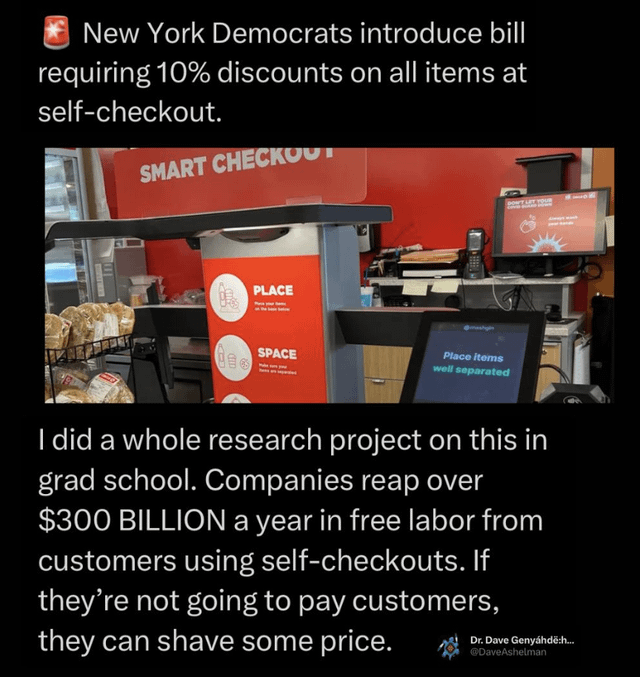
I didn’t have to do a whole research paper on this to know that if I’m doing somebody else’s job as a customer, the company is saving money.
Right, because if I self checkout my $200 grocery bill, that worker definitely would have made $20 in that few minute interaction.
I like the idea, but that’s a terrible implementation. The cost of the bill has no relation to the money saved by using the machine and firing a worker. A flat amount no more than a % of the bill is tiny would be better. Like $1-3 but no more than 5% of bill.
What I’m hearing is NY Democrats are working to pass a bill that will increase prices at businesses using self-checkout by 10 percent. They aren’t going to cut into their own profits.
The fun part that I have heard from a few retail managers is that the software that the self checkout uses costs as much or more per month than the employee would have.
Now watch as Hochul kills it because “it’s bad for the economy”.
Won’t this just encourage people to use self-checkout as it will make using an employed checkout lane more expensive?
I don’t think many people know how harmful self-checkout is to their neighbors employed the store. I made a comment to a Costco employee about how I was glad they added the hand scanners to self-checkout, and their response was to educate me that self-checkout isn’t good for the employees because it means fewer jobs. I’m was so self-absorbed in my own day-to-day life that I did not even think about the impact it had on Costco employees. I didn’t even think about the fact that here I am talking about this pain point of self-checkout (having to use the stationary scanner) and relief about having a better option (the hand scanner) when the best option is already there (employees handling the checkout). The real solution is to just open up more jobs, hire more employees to do the scanning and bagging. I stopped using self-checkout after that.
I went to Aldi recently. You have to put a quarter in to get a shopping cart (I haven’t carried around quarters in ages). The shelves often get into a state of disarray. The line for the 1 employee doing checkout is massive, but self-checkout is also a huge pain in the ass. Continuously cutting jobs to increase profits is a race to the bottom, and yet people who can barely afford groceries think they couldn’t live without a discount chain like Aldi. We are saving pennies by giving up our time doing our own checkout, when we could be getting paid to check people out, providing them some convenience and doing so with greater efficiency instead. I’ll add that many items at Aldi’s are actually more expensive than at other grocery stores, if you’re not paying attention you could end up paying more than a place with more employed checkout lanes.
“democrats” “fighting for worker rights”, are we doing this in big 26? No wonder american left is dead.
It seems like they will just mark everything up by 10% and then give that discount at self checkout. So they will pocket even more while harming those who don’t use self checkout.
Or eliminating cashiers altogether.
It also doesn’t really make sense to do it as a percentage. A cashier’s wage is typically hourly, and the labor market has settled on a particular wage for cashiers in this area - say $15/hr.
If I have a $150 grocery bill, a 10% discount would be $15. For maybe 5 minutes of work. Working out to an hourly wage of $180/hr (60/5 = 12, 12 * 15 = 180).
So if they’re saying “we should be compensating customers for being made to do labor”, they’d be compensating them at roughly 12x the going rate for cashiers in this example.
Now if it’s just meant to be punitive, OK. But then why not actually address the real issue: displacement of workers by technology and passing the labor burden on to unpaid consumers - either make that illegal or tax the company to help mitigate the harm it’s causing by eliminating jobs.
Imagine the lines at self checkout for ~$10(+) off on decent-sized carts
$100 is a decent basket where I’m at…
$100 isn’t much of a big cart these days. That’s a week or less of food for many.
For the last point, it is easier to tax unfavored behavior into the ground than it is to outright forbid it. That’s why sin taxes exist after all.
I don’t think it would be difficult to outright forbid self-checkout at all, actually.
There’s a difference between enforcing laws on individuals and enforcing laws on businesses. Businesses can’t exactly run and hide, if they’re using self-checkout they’re going to get found out. That’s distinct from something like the drug trade, which is all underground and hidden.
Some people fucking love self checkout. If you ban it, you’ll have disability advocacy groups up your arse on behalf of autistic people and others with social anxiety.
ADA compliance will kill the entire thing. You can’t charge someone for accommodation of a disability that prevents them from using the self checkout. All the human-staffed registers will be posted as handicap accessible, and they will default to the “discounted” self-checkout price.
when I recently went back to using a staffed lane, I told the folks I had anxiety about being in the lane, and the cashiers comforted me.
I have social anxiety, practicing in the staff lane, has helped me with this. At least, in this small area of life.
I get the point, but if a person doesnt ever push themselves, they wont grow.
Sure, I’m just saying, this wouldn’t be a hard law to enforce.
It would be a very dumb law that has zero chance of passing. It would be like banning cars to keep horses employed.
Except horses aren’t allowed to vote, so actually, it’s nothing like that.
We’ve given up so much as consumers. There was a time when people would be pissed that the store was making them do unpaid labor. Now we don’t bat an eye.
My concern here is less about enforcement and more about getting the law passed and through the court system in the first place.
You don’t think they’ll drag such a tax through the court system? Our enemies don’t want any restraints on businesses, anything we try to do will be fought.
Do sin taxes really stop anything though?
They definitely have some effect, simply because they push prices up.
If I have a $150 grocery bill, a 10% discount would be $15.
If you have a $150 grocery bill, it’s being hiked to ~$166.66 before you get to the checkout. Then the 10% discount is bringing it back down to the $150 you were paying before. The net discount is zero: you’re paying exactly what you’re paying now.
If you keep going to the cashier after this, you’re paying the company the hiked price, which gives them an extra $16.66 for maybe 5 minutes of cashier labor. The company turns around and pays the cashier $1.66, netting an extra $15 from you for their shareholders.
Cost of labor, overhead, and profit are already accounted for in that $150 price of the goods. That’s why the store charges $150 for them - because that’s what covers the wages, overhead, and includes the maximum markup they can get away with (~3% margin for grocery stores afaik).
All I’m saying is, they do have to be able to cover costs. So because of that and their thin margins, they’d just hike prices (probably more than they’d need to take advantage of the situation).
So it makes more sense to either tax them for avoiding using human labor and passing that labor on to customers (to help pay for the drain they’re placing on the economy by not hiring people), or just ban the practice outright. Couple that with price controls to ensure they can’t unfairly inflate prices. Things they can’t avoid rather than a fee they can hike prices to avoid.
or tax the company to help mitigate the harm it’s causing by eliminating jobs.
Well. Discounting items in self-checkout is actually a tax on the company for using self-checkout.
But not one that relates to the thing that we’re trying to stop them from doing. Cashiers aren’t paid per item scanned, they don’t get commission. They are paid an hourly wage.
If you wanted to pay customers a rebate for their labor at the market rate for a cashier, or one set by the state, that’d make sense to eliminate the gains the company receives from automation.
So 5 minutes of work at $15/hr = $1.25. So not much, but it mitigates the benefit of not hiring people.
Though, it’s still a benefit because you pay a person whether they’re actively working or not and you have to pay tax on human labor (contributing to social security, etc) so maybe hiking it higher than whatever the typical wage is for cashiers would make sense.
But either way, 10% doesn’t make sense.
Can you imagine if they discounted it based on time? People would be scanning .4 items per minute lol
The problem with your logic is that I can scan the items slower and make the compensation more fair, if I scan the items 12x slower then I’m being paid a fair wage for that 150$ purchase.
So am I being punished for being fast?
That’s the only way it could work.
Grocery stores average margins of ~3%. They can’t do universal 10% discounts.The CEO of Kroger made $15.63 million in 2024. Pretty sure there are lots of ways they could make it work. They choose not to.
That’s not how math works.
2024
Revenue was $147B
Profit was $3.8B or 2.8%The lowest estimate I found of sales volume through self checkout is 38%.
So a 10% self checkout discount is 3.8% hit to revenue. When profits are only 2.8% they’ll take a 1% loss.The CEO pay being only 0.4% of that $3.8B profit. Isn’t remotely enough to matter.
This won’t lower prices.
Do you think the CEO compensation is the only place they are siphoning off funds to the oligarchs? And even with all the greed, they are still admitting to robbing $3.8B from the working class. That’s all profits are.
The system rewards greed and corruption. So that’s what they do. They conspire with other corporations to inflate prices. They take advantage of disasters to gouge consumers. These aren’t conspiracies, they are things that have been admitted to under oath and discovered through investigation.
The numbers are public. You can do the math and convince us.
say you’ve never worked in accounting without saying it
They’re welcome to lie with the numbers! But then I can at least reason about it. Right now, we’re looking at some cherry-picked end points and ignoring the proposed numerics entirely.
We’re looking a 2 different things here. I’m doing the math on a specific policy and how it would effect a specific company. You come back with generalizations and broad conceptions.
You are right generally. We agree generally. But here specifically, this policy won’t do anything to help that. It’s bad policy-making. We’re both right.
That’s an abysmally small number compared to the amount of product they move.
Yes, sure, CEO’s should make less. But that amounts to fractions of a percent on the typical purchase, not 10%.
Sure they can. They hike prices 11.11% and the 10% discount brings them right back to their original price. Their 3% margin stays a 3% margin. They can even post the “discounted” price on the shelves to make it seem like customers are getting a good deal.
Yah. That’s what was already pointed out.
You’re pretending that stores can just arbitrarily raise prices. They already set their prices as the maximum the market will bear. And yes, ultimately the point is to make self-checkout cheaper than regular.
They arbitrarily raise prices all the time. Have you not noticed? And are you going to just stop eating food if it suddenly costs 10 percent more?
You think that was arbitrary? Do you have any idea how much work stores put in to setting prices? It’s more complex than this, but to illustrate, companies will maximize for total revenue, so quantity sold times price. And they know that whenever they raise the price, even by ten cents, some number of people will not purchase that item. They only raise prices if they predict the decline in sales will be more than offset by the increase in revenue per item.
It may seem arbitrary to you, but it’s anything but. The prices in the store are already at what the company estimates to be the optimum total revenue level.
yeah you’re right about your point so far, but this is different. if every grocery store in town were forced to raise prices by 5%, then they could all do it because all their competition does it too.
but if only one store decides to do it, then the customers would change to the other store nearby who offers lower prices.
Note that cheaper self-checkout means more demand for it (and less demand for cashiers). So we’ll have fewer jobs, and worse service for those who can’t (for w/e reason) use self-checkout.
Most of its happening anyway.
That “$300 billion” number is just completely made up. The math doesn’t even remotely work.
The entire US grocery industry does somewhere around $1 trillion in revenue per year. For self-checkout to save $300 billion, that would mean roughly a third of every dollar spent on groceries was going directly to cashier wages. That is obviously not how grocery stores operate. Total labor costs for a store are only a fraction of their expenses.
And the idea that self-checkout was some massive money-saving miracle ignores the other side of the equation. Those systems cost a lot upfront, require maintenance, and they increase losses from theft, missed scans, and mistakes. A machine replacing a cashier doesn’t magically eliminate costs; it just moves them somewhere else.
There is a reason companies like Walmart, Target, and Dollar General have started putting limits on self-checkout or bringing back more staffed lanes. If self-checkout was saving them hundreds of billions, they wouldn’t be walking it back. They would be installing them everywhere they could.
This is the kind of post that hurts any community built around open discussion and critical thinking. A sensational claim gets repeated because it supports a certain viewpoint, while nobody stops to ask if it is actually true. The truth should matter regardless of whether it supports corporations, consumers, or anyone else. Being intellectually honest means checking the facts first, not just accepting information because it confirms what we already believe.
On a side note, totally support the bill in every way.
I frequent a DG Market in a rural area. They shut the self checkouts down pretty quick due to theft.
deleted by creator
I really thought leaving Reddit would reduce the occurrence of this but honestly it was naive of me. This sort of clickbait crap is everywhere including Lemmy. Its unfortunate
Reddit is a cesspool but unfortunately so is the wider media ecosystem for the most part.
Highly upvoted too. Yes it is exactly the same here, just a little different biases.
It’s a shame because I can’t find a platform to get away from this type of nonsense. It’s all the same, false claim is made and nobody even asks if claim is true they just assume it is and start arguing about it in the comments.
Like, what’s the point? Wish there was a platform similar to this that actually permanently banned people sharing blatantly false or misleading content.
To further add some numbers (and their source) to this, the average grocery cashier makes $15-16 an hour, or liberally $35k a year. Note that this isn’t the entire cost of a cashier, the checkout equipment and POS systems cost money too - let’s assume that and the automatic checkout system are in the same order of magnitude. There were about 800k grocery store cashiers in the US in 2017 (source) so that’s about $28 billion, or ~3% of that proposed $1T revenue.
Many factors not included in this calc, more importantly regional variations in costs. Food prices and wages are higher than average in NY, 10% might not be pretty well calculated for that state. Also, human employees must be insured/have benefits, and machines do not require this. That cost savings on stores isn’t in the calculus here.
Also a huge fan of holding food chains accountable for fair pricing. Hope this becomes effective!
honestly just cap executive pay. nothing they can do then
In fact, let’s just screw the whole thing and seize the means of production…
“seize the means of production” as if that’s an easy/good thing to do. then what, the employees own the company? and they get paid depending on company profitability? well, not every company turns a profit. what if the company has a bad year? will the employees go hungry? who says that it will turn a profit next year?
Then the employees decide what to do themselves in those situations. If it fails it fails, but they would be laid off or not be making money even if they didn’t own the company because their boss wouldn’t be able to pay them.
Bang up idea, when have you ever seen the government run something correctly/efficiently?
train networks, schools, healthcare, heck even social housing, here in central europe
USPS?
There’s tons of examples if you actually care to look. Trash pickup is an easy example. I’ve lived in places where it was managed by the city and places where it was run by private companies. The city always showed up on time and never raised prices without justification.
Guess what the private companies did on a regular basis? And if you want to talk about efficiency let’s consider whether or not it would be better to have four different companies running four sets of trucks on four overlapping routes through the city as opposed to one entity handling the whole thing. The only thing efficient about the private companies running things is the way the money is siphoned off to some rich asshole instead of being managed by accountable local officials.
If its so efficient why do trash companies exist? I live in a city that has municipal pickup and all my friends that own apartments/restaurants all have private business dumpsters because the city sucks at doing a simple job…
The government needs to stay in its lane and out of business.
so i can tell you from an example why private companies exist that do things that are typically done by public companies … here in austria, there’s a railway operator called WestBahn. They provide passenger trains on the route from vienna to innsbruck (roughly). That’s the only route that they service. Why do they do it?
because it’s one of the most provitable routes in all of austria. it has many, reliable passengers. servicing that route turns a profit. servicing many other routes, for example bus lines in some remote village, is still necessary, but obviously doesn’t turn a profit as it has maybe 3 passengers at a time.
so, they pick the 1 route that’s actually very profitable, only service that, and leave every other route to the state-owned alternative. that’s what’s happening.
If its so efficient why do trash companies exist?
If private companies are so efficient then why does the government exist?
Do you see why framing the question that way doesn’t help you address the actual problem? I’m guessing you don’t since you seem unwilling to consider the possibility that private ownership is not the ideal solution to every service problem. I don’t think you need more than a cursory glance at the state of the US to throw that idea out the window but things must seem pretty good to you if you’re still stuck in that mindset.
Not stuck in any “mindset”. Been around the block a couple of times, not my first bbq, and every time any government gets involved they fuck it up and steal. Nope not on my watch.
And government exists as (and was intended) to hold the social contract we all have with each other together by the rule of law. Otherwise it entropy.
whether your government only makes chaor or actually helps, depends a whole lot on the government and especially on the people in it. there are good governments, for example here in austria.
the issue is more, whether your government represents you and whether they care about you. that is something that depends on your local context.
Been around the block a couple of times
So has your 5 trash companies
The police and most three letter agencies, when you understand their purpose is to protect the wealthy.
Works for me.
the government
Who said shit about the government?
We should seize the means of production. Us.
seize
in other words, steal. i’m actually fine with that if it’s for the greater good. the question is: would it work? do you have any idea how to run a company on that scale? there’s a whole lot of companies that have business connections all around the world. what happens to those? can you handle these connections? what if other companies think that you’re not trustworthy anymore and refuse to do business with you? how do you handle these cases?
also what about money? just that the company is now held by workers does not somehow suddenly make it have much more money. especially grocery stores maybe have 3% profit margins, that means, even if no CEO siphons off wealth, the company’s ability to spend money increases by maybe 3%, so wages could go up 3%. just to inform you, about what’s realistic here. it’s not as if you’re suddenly having a 3x wage increase.
in other words, steal.
Not quite. “Steal” would imply that the people you’re taking it from have a legitimate claim of ownership over it.
do you have any idea how to run a company on that scale?
Some of us do. And maybe it doesn’t need to be such a large scale in the first place.
what if other companies think that you’re not trustworthy anymore and refuse to do business with you?
Seize them too.
also what about money? just that the company is now held by workers does not somehow suddenly make it have much more money. especially grocery stores maybe have 3% profit margins, that means, even if no CEO siphons off wealth, the company’s ability to spend money increases by maybe 3%, so wages could go up 3%. just to inform you, about what’s realistic here. it’s not as if you’re suddenly having a 3x wage increase.
What about money? If we have the labor, the tools, the farms, and the factories … what do we need money for?
i think you’re unreasonably assuming here that a revolution would happen everywhere on the planet at the same time. realistically, that’s not the case. you start with one place, then another, etc. and in the meantime you have exactly the problems that i cited. how to interact with other entities, etc?
Good luck with that bub.
The difference is that the government has no shareholders or incentive to turn a profit, unlike companies. However it can sell luxury goods at a high price, to subside other goods like food or housing from the markup.
No share holder, we are all share holder in the US government if you pay taxes, are you daft?
Oh wow, where are my us government shares? When are the dividends getting paid out? Can I vote to invest more of my taxes into public schools so the education system does not fail it’s shareholders?
You have safety, food standards, drug standard, medical standards, social safety nets, roads, etc.
Thats the shit they are ok at, the rest leave it to companies.
And how does this work out? Do companies not lobby against safety or environmental regulations if it hurts their profits? Is the water safe to drink everywhere? Is medical care available to everyone who needs it, regardless of income? Does everyone get social security, even if he could not pay in because of health issues, accidents or other reasons that prevented him from working full time for 40 years?
You have safety, food standards, drug standard, medical standards, social safety nets, roads, etc.
And they’ve all been gutted starting with Nixon.
Try harder troll.
It’s not the government who would control the means of production, it’s the workers. In theory they might use a vanguard party to seize it non-violently and then redistribute it, so in that case it may pass through the government’s hands. But that’s not the only way to seize the means of production. When properly done though, it would end up in the hands of the workers, every laborer owning their own tools and equipment so they can work for themselves instead of some faceless corporation.
A lot more frequently than I see private industry run something correctly/efficiently.
Arent they often paid in stock?
Define pay such that it includes stocks, bonuses, rebates, real estate, food, clothing, transportation, or any other item that can be exchanged, borrowed against, or otherwise converted to cash money. When they find a loophole just close it.
The problem with this isn’t the concept. It’s getting politicians to implement it.
It’s a pretty good loophole though. A stocks value is considered an unrealized gain when you receive it but don’t sell it. My company gives me stock, but I don’t sell it. If I had to pay taxes on that, I’d be fucked. Maybe they could create some kind of untaxed minimum based on some index. And possibly even brackets.
But of course there’s a reason they like it this way.
Stocks are not a necessary piece of compensation for anyone. Besides, if you can borrow money from a bank using stocks as collateral then it is effectively a liquid asset that you absolutely should pay tax on. The simplest solution to that problem is to disallow stocks from being used as collateral.
Every loophole can be closed if we decide we want to. The ones that are still open were intentionally left open to benefit the rich.
I think if they handled it in such a way that you borrow against it in any fashion, what you borrow is taxed. Kind of stupid it isn’t that way already, but here we are.
Except where I live you do actually have to pay taxes on stock you receive as a bonus, if you don’t have the cash on hand, you just liquidate part of the stocks.
Yep, this is one of the reasons we need a tax on wealth. If you’re wealthy enough you can also just borrow against your stocks at very low interest rates.
Surely the us president will get right on it drafting an executive order!
This is a good intentioned, well-principled idea, but it’s a ham-fisted implementation that isn’t going to have the intended effect and extremely easy to work around.
How is this a principled idea? There are countless examples across the economy where we have these labor tradeoffs. Building your own IKEA furniture. Picking up food yourself instead of getting it delivered. Yet we almost never have politicians come in and try to impose price controls on this deferred labor.
Doesn’t seem that easy to work around. A checkout is either self checkout or it isn’t. Write the law to define a self checkout as “a check out where the majority of items are scanned by a customer rather than an employee.”
The Amazon Fresh technology is already a loophole to that.
And why do you figure you can’t write a law to accommodate that as well? Some of you guys are looking for so many nits to pick that you think it would be impossible to ever write a law regulating anything whatsoever.
I’m pretty well read in economics. This is a well known concept called unintended consequences. People who are familiar know that there are endless ways to game any system and we tend to prefer very simple rules.
That’s because you don’t have the mindset of a sleazy corporate lawyer who is paid $500,000 a year.
Try this: Raise all the prices by 10 per cent. Give the 10 per cent discount to self-checkout customers, as required by law. Pocket the extra for people who are stupid enough to use the self-checkout. Don’t forget to give a middle finger to your local elderly people or disabled people. They’ll now pay extra for the privilege of shopping.
You do realize that the prices in the store right now are already the maximum the stores can charge, do you not?
Corporations are soulless and greedy. They don’t set their prices by buying from a supplier and increasing them by a fixed percentage. There is no point where a company will go, “well, we could charge more and still have the product sell, but that would be improper.” They already set their prices to the maximum the market will bear. They cannot raise prices further without a net loss of income. They set their prices for the maximum product sales cost and quantity sold.
And why can’t the elderly or disabled use self-checkout? If you’re capable enough to walk through a store and grab items from shelves, you’re capable enough to slide them past a scanner. If they’re shopping with a caretaker, then the caretaker can run the check-out instead. The level of dexterity required to use a self-checkout is the same as needed to grab items from shelves, inspect and bag produce, etc. Sure, some people are too disabled to use a self-checkout, but those folks are also too disabled to shop for themselves at all. That was literally how these systems were designed. The companies didn’t want to have to deal with scores of people who were dexterous enough to shop, but not dexterous enough to run the self-checkout.
What do you mean maximum? There’s no cap, as we’ve seen from the way prices have already been rising.
Why doesn’t your grocery store charge $20 for a gallon of milk then if they can just raise prices as much as they want? Have you never even heard of supply and demand?
Let me spell this out for you.
Discount on self-checkout passes.
Stores raise prices so that the price after the discount is the same as it was before.
Consumers continue to pay the prices they’ve been paying.
‘Discount’ evaporates into the aether.
the thing that you may not be considering here is the increased competition from the new city-run grocery stores that are also being proposed will somewhat limit the traditional store’s pricing power since presumably the city stores only need to break even, not turn a profit, and the city stores might not need to pay some set of taxes. we’ll have to see if this actually plays out, but that’s the proposal.
my guess is that large manufacturers like proctor & gamble may not want to supply the city stores, so they may be stocked with lesser known brands, at least at first.
You do realize that the prices in the store right now are already the maximum the stores can charge, do you not?
The market doesn’t see the price hike. You pay $100 today, before I hike the prices. I hike the prices to $111.11, but my shelf labels show you the “discounted” price of $100. You keep paying the $100 price that the market currently bears.
And why can’t the elderly or disabled use self-checkout?
That point was completely irrelevant. If someone can’t use the self checkout, ADA compliance requires accommodation, and the business can’t charge them extra. They get the same discounted price as the self-checkout. So, they put a handicap placard on the cashier stand, train the cashier not to ask any questions about disabilities, and give the same “discount” to anyone who uses the register.
4.90
Includes self-checkout discount. Price without self-checkout discount: 5.44
I don’t think this addresses anything I said. Market constraints prevent them from raising prices, not math. I perfectly understand the math you’re describing. You’re failing to understand the economics.
I’m saying the economics don’t matter because you can trick people into thinking prices haven’t gone up.
For ADA compliance purposes, the human cashiers have to give disabled customers the same rate as the self checkout. If I’m running a store, all my staffed checkouts will have handicapped placards, and cashiers will be trained not to inquire as to disability status, but merely “accommodate” everyone in line.
Now everyone is getting the “discount”.
Can we go for upcharges on food items for modifying them next? If you are going to charge me $0.30 for adding tomatoes to a sandwich, you better damn well reduce the price by $0.30 when I remove tomatoes from a sandwich.
This is getting so out of hand in the USA.
Oh that’s one of my gripes. My son likes to get an egg mcmuffin with no meat, extra cheese. You’d think the slice of meat and cheese would cancel each other out. And I think they are up to charging $1 for a slice of american cheese. And its been this way for over 15 years.
It’s not just the US. The race for the biggest profit has hit its limits on the best value front. Now it’s pretty much all on deception and enshittification.
Fun fact: With very little effort, you can give yourself a discount at checkout!
Unethical corporations are humanity’s predators and we should hurt them however we can.
I grab my zero dollar curtesy gum every time I am at one.

This is why I try to avoid self checkout. If I’m getting like 2 things and there’s already a line, sure, maybe… But if the lines are short, even if I only have a couple of things, I’ll visit a real cashier.
Not because I need help with it, and not because I want to “stick it to the man” or anything. I want to be part of the metric that continues to justify that a cashier is still a position to keep, and pay someone for. I do it so that there will still be cashier’s in the future, and someone can put food on their table because I didn’t choose to do free labor for the 0.1%.
I know, I know. I’m so selfish, I should tHiNk oF ThE sHaReHoLdErS…
“Cashier” has pretty much always been a heavily exploited, poverty-wage position. Cashiers might be putting food on the table, but their dickhead bosses aren’t paying them a living wage. They aren’t putting roofs over heads, or kids through college. Turnover is ridiculously, criminally high. People aren’t getting fired when the position is eliminated. They are leaving just as fast as they already were, and they aren’t being replaced.
The position is used to systematically exploit workers. Eliminating that position is a net positive.
I’m going to disagree with you there.
If your cashier’s are not making a living wage, then maybe the minimum wage should be increased?
Where I am, if a minimum wage worker worked 40 hours a week consistently, they would go home with the equivalent of $26k USD. The US Federal minimum wage at 40hrs/week will net you $15k USD.
The job isn’t always for the impoverished, and if it were, and you were to eliminate it, you just put people who are already impoverished into homelessness because they no longer have any viable means of employment.
The people leaving the job is a net positive because they should be, in theory, moving on to better paying positions. Freeing up jobs for people who need the work and can’t find it elsewhere.
It’s better than working in an Amazon warehouse.
Also, I worked at grocery stores a lot when I was a younger person and I was never a cashier, but I knew most of them and I was able to go back there years and years after I left and see the same faces at the tills. A lot of wives with empty nests helping to save up for retirement, or simply to do something during the day while their kids are off at school or whatever…
A lot of people working to help pay their way through college or university.
There were a lot of people working at those jobs for years and years because they needed something to help make ends meet until they could graduate, retire, find a job in their field, pay off their mortgage… Whatever it was.
You having this opinion indicates to me that you haven’t worked at a major retailer, or you’ve never worked as a cashier. I’m not sure which and bluntly I don’t really care. My lived experience disagrees with your pessimistic world view.
If your cashier’s are not making a living wage, then maybe the minimum wage should be increased?
Minimum wage is certainly too low. It should be more than double its current hourly rate, but that’s not the main problem here.
Where I am, if a minimum wage worker worked 40 hours a week consistently,
Cashiers are rarely allowed to work full-time hours. Management keeps the position open only for part-time workers. Cynically, the reason for this is so they don’t have to provide benefits to those workers. Giving retailers the full benefit of the doubt, this keeps a surplus of workers on the payroll, allowing the retailer to schedule everybody during major shopping events like Black Friday. Regardless, these workers are typically denied sufficient hours to be able to earn a living wage.
The job isn’t always for the impoverished,
You’ve got it backwards. The job isn’t for workers who happen to be impoverished. The impoverishment is because the job does not compensate workers adequately.
Also, I worked at grocery stores a lot when I was a younger person and I was never a cashier, but I knew most of them and I was able to go back there years and years after I left and see the same faces at the tills. A lot of wives with empty nests helping to save up for retirement, or simply to do something during the day while their kids are off at school or whatever…
So, you’re saying that these workers are holding these jobs for something other than gainful employment? They are using them as some sort of hobby or recreation? They are willing and able to accept exploitative conditions because they aren’t actually trying to live off the fruits of their labor?
The people you are talking about are, ultimately, enabling this exploitative behavior from employers. They are competing for work with people who do need actual gainful employment. Their recreational participation in the workforce devalues the labor of everyone else. I’m not saying they shouldn’t be allowed to work recreationally, or that employers shouldn’t be able to hire them. I’m saying that this practice should be strictly regulated, so that the employer can’t use their willingness to be exploited to justify exploiting everyone.
I think we need to establish both a “minimum wage” and a “standard wage”. The minimum wage would be the fixed, hourly minimum rate that we already have . The “standard wage” would multiply the minimum wage by 40 hours a week. Employees who aren’t paid at least that weekly amount are on “substandard employment”. A 40-hour/wk worker earning minimum wage makes a standard wage. A 20-hour/wk worker earning 2x minimum wage makes a standard wage. Substandard wages should be allowed, but restricted. An employer should not be allowed to compensate more than 10% of its labor with substandard wages.
I see what you’re driving at, but all employment is exploitative. There’s always a measure of the work that any low-level employee does that they will not get compensation for, that’s how business operates. That’s profit.
Whether someone is able to work at a position full-time or not, isn’t really the point I’m making here. Long gone are the days of the minimum wage being a living wage, no matter how much we try, we’ll never catch up to the inflation that’s happened since the minimum wage was set. Companies won’t let it happen. As minimum wages go up, so will prices, and you’ll always be in a never-ending cat-and-mouse game of raising wages, vs raising prices. The two will never be at the same ratio of earnings again. Minimum wage earners will never have the same buying power that they did when the minimum wage was put in place.
Our buying power will continue to be eroded away, in small amounts, forever. Minimum wage positions will always be, by definition, more exploitative than other positions, but all jobs are going to continue to exploit the work that people do. That’s capitalism in a nutshell though. I’m not proposing a better system, just stating facts. That fact makes a lot of what you’re driving towards, apply to a much broader group of people than just the exploited minimum wage, impoverished workers. The lowest earners will always need to be supplemented by something, whether that’s a food bank, food stamps, rent control, government programs to reduce costs, taxes, or other fees associated with living, or by the income of another person. I don’t think Minimum wage earners will ever be able to be financially independent, even if they could have been at one point or another.
By cutting any job, you’re shrinking the pool of jobs available for entry level workers. A pool that’s continually shrinking already. I will happily do whatever I can to reduce how much that’s shrinking as often as I can.
If you need a hammer or a torque wrench or a truck to do an ongoing job, compensation for that job must be sufficient to pay for the continuing maintenance and eventual replacement of that hammer, torque wrench, or truck.
If you hire a human to do a job, compensation for that job must be sufficient to fully meet that human’s basic needs. They need to be earning enough to be a fully functional member of society, not an impoverished charity case. They need at least a living wage, where they don’t have to choose between excessive employment or going without. A living wage (or better) is not exploitative.
Generally speaking, cashiers aren’t earning a living wage, let alone a gainful wage. Cashiers are generally exploited.
As minimum wages go up, so will prices,
There’s a glaring flaw in your analysis. Increasing minimum wage increases effective purchasing power much faster than it increases prices.
And yet people still work as “Cashier” if they can get the job,
Wonder why…
Oh, wait, it’s because the alternative of having no job and no income IS EVEN WORSE.
Welcome the Capitalism!
True. Very true. But the solution to that problem is a completely different conversation than what we have been having in this thread. That conversation starts with a “citizenship dividend”.
Democracy takes the political power of the individual, conveys it to government, where it is used to provide all manner of services. Those services are available to everyone, but they are not utilized equally by everyone.
The individual is not currently compensated for the use of their political power. We are taxed proportional to those services that we use, but those taxes don’t make it back to the source of the power that enabled those services.
That should change.
Each of us should be individually compensated for the government’s use of our political power. We should each receive an equal dividend. The most common term for this dividend is “Universal Basic Income”, and it should be enough for the food on our tables and the roofs over our heads. We should receive that income before we get out of bed on Monday morning. The 40 hours we typically work in the week should not be for basic subsistence, but should be entirely gainful.
The discount comes from entering the code of the cheapest type of item no matter what item I picked up. Organic lady finger bananas? Looks like bulk Cavendish to me. I’m not being paid enough to know the difference when I’m using self checkout, a banana is a banana.
this is why the store near me changed the self check programing and added AI
No more codes, point to the picture
Great! Now AI is going to hallucinate products and if you don’t pay attention, you’ll be overcharged. Since it’s “self-checkout”, I bet they’ll claim it’s totally your responsibility to make sure you’re not ripped.
Self checkouts don’t use agentic AIs / LLMs that hallucinate permanently. As mich as I hate AI, that’s one of the cases where the distinct types matter.
Image recognition software has been around for ages and was used for similar things way before the AI hype. The models used for selfcheckouts are highly specialised and have an error rate very close to 0%. That doesnt mean they can’t make any errors, but the same goes for human cashiers.
A SCO I use regularly loves ringing the third b2g1 item as something different. I swear it hallucinates to avoid sales.
Most self checkout machines rely on weight, so you have to find two items that weigh the same for that trick to work.
1lb of expensive bananas is indistinguishable from 1lb of cheap bananas in most of the self checkout machines I have used. Maybe one day they will get advanced cameras