- cross-posted to:
- technology@lemmy.zip
- technology@lemmy.ml

- cross-posted to:
- technology@lemmy.zip
- technology@lemmy.ml
You must log in or # to comment.
The thing that people miss in this is that the feature they’re seeking by putting servers in space is only to have servers outside of any jurisdiction, with the advantages that it might bring
Whatever company owns it will be responsible for it. That company will answer to whoever it needs to here on earth.
you think us sub-millionaires have any power in government, huh?
Imagine spending 10 years to build a server in space to avoid some law and next month government changes the law
This is 1 million% what’s at play here. Tech bros HATE that they have to deal with stupid laws, and putting a server outside of the jurisdiction of literally every country is a dream. A giant server ship has to dock, it needs fuel…not so with something in orbit (in Elon fantasy land anyway)
Now that is actually smart
Well its a great ideal if you happen to be a company with a space program, sounds like a very lucrative venture.
Ridiculous, you can’t have cloud computing in space, there’s no atmosphere!
I don’t think the point is to really build datacenters in space. The point is to convince investors that it can be done in a profitable manner so some people can create a fake businesses out of it and siphon money off the system. Much like the same as trying to convince investors that LLM + more money = AGI
I also wonder if this is an entire red herring. There are increasing reasons for more compute in space, such as to pre-filter sensor data.
Is it to naive/optimistic to think no one is actually looking for a space datacenter to compute terrestrial loads, but they recognize the need for processing space loads?
See now you all are thinking.
The rich wouldn’t tell us this shit if it wasn’t going to be used as some spin/distraction whatever it is.
It’s a legal thing. No (real) jurisdiction. In space nobody will shut down Grok generating kiddo porn. It’s basically the precursor for Epstein Island 2.0.
Just tell Elmo to add bigger CPU and GPU fans. That’ll work.
Don’t data-centers require massive cooling?
Yes, and it’s easier to cool things on earth. In space, there’s no air to help you cool thinks off, you can only reject heat through radiation. Most spacecraft are carefully designed to reflect heat/light on surfaces facing the sun and radiate heat into empty space from surfaces that are shaded.
In space there’s no epa
What if you build it on an asteroid or moon or planet. Uranus is ~-225⁰C, right?
Yes I’d like to build data centres on Uranus one of the most distant planets in our solar system, and also one without a solid surface but who’s counting.
Yes, but the two-and-a-half hour lag each way would be a killer.
My understanding is that these “datacenters” would be used exclusively for model training, where latency doesn’t matter.
It is still an outrageously stupid idea for a zillion other engineering reasons, though.
There’s also the issue that around once a year the two planets will be on opposite sides of the sun. Not only would you have a lag of close to 3 hours, but communication would be completely impossible for a month or so at a time.
It would need to have an atmosphere, so asteroids and most (all? Idk not an astronomer) moons are out.
Mars might be feasible at some point in the far future, but there’s still the lag problem of 3-20 minutes depending on time of year, so not very useful for anything user facing.
most moons
Pretty much every moon but Titan. Titan, however, would be excellent for heat dissipation. Long before generative AI was even a thing, scientists have speculated that Titan would be the perfect place for datacenters because low-temperature computation is so much more efficient.
Of course, building a datacenter on Titan would be a several-hundred-trillion dollar endeavor, so… good luck bootstrapping your way into that industry.
None of the moons in our solar system have atmospheres. Earths moon is too small to hold on to an atmosphere, and the Galilean moons of Jupiter are too cold for an atmosphere, the gases just freeze.
The best place would be either a space station in low earth orbit or of the L4 or L5 point. The data issue would be the problem though I suppose you could just use the data centres for training but not for active processing but then you would need to build data centres on earth for that.
Given that you’re going to build the earth data centres anyway you might as well do all of the processing on earth at the same time.
None of the moons in our solar system have atmospheres.
Except for Titan. Titan has a lot of atmosphere.
Considering the ludicrous price to put each pound of equipment into orbit, I’d like to invite them to send as much hardware as they can in to (high) geostationary orbit so they can find out how well a vacuum does NOT promote radiating heat
Edit: also forgot about solar radiation flipping bits. I love the idea of them having to reboot the machine (if they even can) remotely once ever 15 minutes
Whatever happened to resource efficiency, being able to do more for less energy? This whole thing is super unsustainable.
Making reusable rockets is impossible and stupid. Electric cars are stupid and wont work. Satellite internet is too expensive and stupid. So far Elmo is batting 3 for 3 and I am going to bet he can make it work. Unlike the CyberTruck
More nuanced (and without using the word “stupid”)
- Making reusable rockets is very difficult. It was high risk, high reward.
- Electric cars were always the climate change solution IF the battery gets good enough. And it got good enough. I hate my country’s car industry (I’m from Germany) for not getting their asses up.
- Satellite internet is in fact too expensive for average customers. I think, no on has ever declared it as bad for people in regions without existing internet intrastructure. The question is how profitable it is, but it’s not publicly traded, so we will probably not get the numbers.
For sure, Elmo can somehow make profit out of it, e.g. by selling the space cloud usage as “can’t be controlled by an government on earth” for a high price. But when we concentrate on the facts: It can’t be more efficient than Azure or AWS on earth, at least not for the next decades.
The Russians spat at his feet when he asked to buy their rocket engines, lots of naysayers. I have and love my starlink.
none of these things “have worked” they just represent a privately subsidized shift in infrastructure and society. there is no such thing as progress, you progressive
gleaming eyes wide open
I am biased because I have starklink and love it. It works…but before Elon worked on his vision for re usable rockets it was a dream. He changed the world.
There’s another problem that nobody mentions. Putting thousands of additional satellites into space would seriously increase the risk of Kessler Syndrome occurring.
This isn’t true for low orbit items. They will come down on their own in ~5 years.
At the absolute worst case scenario, we’d be blocked or ~5 years. R
Collisions in LEO can chuck debris into orbits which intersect higher orbits. If one of those collides with something in in said higher orbits, you have a problem.
Any orbit resulting from a collision will pass through that collision point unless there’s another collision to change it’s velocity again. The higher a collision sends an object, the more likely the “orbit” intersects with more atmosphere to cause drag, or it might even collide with the ground without drag.
I sincerely doubt that a collision in low earth orbit is going to result in debris being flicked up into geostationary orbits, the energy differences involved are just monumental.
It’s possible it could go to a higher orbit, but we don’t have mega constellations in those orbits. I don’t know enough to know how far something could get flung up either, but I suspect if you’re in a 5y orbit, you aren’t reaching a 50y orbit area, and probably not even a 10y orbit area.
At this point I feel we’d just be immunising the rest of the universe from human stupidity.
Little bit of a nitpick but Kessler syndrome doesn’t care about how many satellites you have, and more about how many dead satellites you have hanging around on random orbits. You could put hundreds of millions of satellites in space as long as you had some sort of decommissioned program. You can always send up rockets if you can just move the satellites out of the way / know where they are.
Dead satellites do add a much larger risk than satellites that can be steered, sure. If we stopped steering all our satellites right now, I believe it’d only take a few days before a collision occurred.
However, every satellite in orbit adds to the risk, especially if a chain reaction starts happening and it becomes very hard to avoid the shrapnel flying around. Or if a once-in-a-century-type solar flare takes out a bunch of satellites.
Edit: Basically, the best way to prevent Kessler Syndrome from occurring, is to keep the number of satellites in orbit below the threshold where it could occur.
In the future cleaning up our LEO zone will be a problem like cleaning up the rubbish in the oceans.
My question is always how the hell are you going to cool them. Do you know hard it is to move heat in a vacuum?
The problems; plural; is that the person who popularized the idea of data centers in space has little to zero understanding of any of the space sciences and yet owns and directs one of the world’s largest, and privately owned, aerospace companies with massive government contracts that splits its time with their own AI work.
We already have data centers in space.
Oh? Good. Problem solved then.
User name checks out, though
How would you power them?
The surface area of solar panels exceeds the surface area needed for radiators to cool everything.
In space I would imagine you’d find the perfect sandwich ratio. One bun solar, one bun radiators, the meat being the racks.
Have you never seen a movie set in space? Evrytime someone gets sucked into space they freeze. You saying every movie got it wrong?? Space is cold. Duh.
Please tell me you aren’t serious.
They are completely cereal!
Super cereal
With extra milk
dude! how do you expect anyone to answer if you don’t say surely you can’t be?
I am serious, and don’t call me dude!
Dude stop
Easy, just create a long heat sink and dangle it in the earth’s atmosphere. Now we are winning!
From that to a space elevator…
With radiators just like with every existing satellite system.
https://youtu.be/DCto6UkBJoI&t=12m57s
Very large scale datacenters would likely have some nasty fluid handling problems to solve.
I’ll just note that I am not a fan of putting internet infrastructure in space. I think polluting the upper atmosphere with a bunch of metals every time a satellite deorbits will certainly have negative consequences. So IMO space should be limited to things we can’t do with earthbound infrastructure.
Removed by mod
And you can only build so many of those radiator panels before you start running into congestion problems. You don’t want them radiating onto each other.
Removed by mod
The area of radiator needed directly corresponds to the amount of power harvested by the solar panels. It doesn’t matter what the load is. So a compute frame with the same amount of solar panels as the space station would need approximately the same radiatot area as the ISS, unless you are bringing nuclear power into the mix.
I agree that space based datacenters are a bad idea, but the thermals really are not the gotcha people are making them out to be.
The solar panels needed is another problem for the space data center fantasy. Once you put together all the mass over enough surface area to make it work, you would blot out the sun worldwide.
They’re called fins. Not panels.
Removed by mod
Removed by mod
Yeah the amount of heat a data center vs a satellite your going to super heat the space in that orbit over time. It they are geostationary then its even harder as the the data center doesn’t move away from the heat.
Geostationary satellites are not standing still. They’re orbiting the Earth at the same rate that it rotates “beneath” them.
Super heat what in that space? The point is there’s nothing to transfer heat to. All you can do is radiate infra-red light.
Um, it doesn’t make the data center in orbit thing make sense, but a geostationary satellite absolute moves at high speed and does not stay in the same place in space.
The heat would be moving at the same speed. Though, that does mean it wouldn’t be any better in any other orbit.
Thermal energy is primarily dissipated as infrared light which moves at the speed of light. There is no way for space to accumulate heat. If that were the case the entire solar system would be unlivable. The IR emitted by satellites is truly negligible in comparison to the electromagnetic radiation emitted by the sun.
Again, it doesn’t help the case, but just… no. The heat gets out of the spacecraft by radiating, and radiation doesn’t move in a circular orbit around Earth, it moves at speed of light outwards from where it started.
Radiators in space work by radiating electromagnetic energy(light). Heat can only accumulate in matter, not in space, so that is definitely not one of the things we need to worry about.
geostationary then its even harder as the the data center doesn’t move away from the heat.
Geostationary would leave the satellite in shadow anytime it was night time over the part of the earth since a geostationary orbit is stationary in the sky over a given point at the equator.
That doesn’t solve any of the cooling problems just saying that you do get some shadow at geostationary orbits.
There are other orbits that get less shadow though.
It’ll be in shadow at midnight, yes, but not necessarily at any other time. Geostationary orbit is at about 7x the radius of the earth.
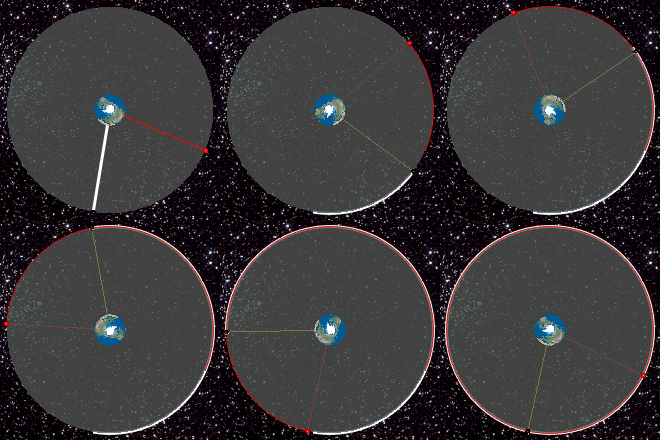
As such, the period when in will actually be in shadow is only a short period directly behind the planet.
A radiator. Next question?
What’s going to be performing convection to dissipate heat from the radiator in a manner to support the heat generated by an AI data center?
Obnoxious as he seems to be, he’s actually right, there will be no convection, but they’d radiate heat in a vacuum, by IR IIRC.
You’d need an enormous radiator to move the heat a data center puts out. Not even all the billionaires put together could afford that.
Sure, the idea is as bad as solar roadways. It’s actually kind of impressive to come up with an idea that bad.
To do that they’d have to be filled with something other than something water based to be able to do that over a large area which would require constant maintenance to do so. It’s not easily feasible and I doubt people who want to do this or defend it realize that. I have to look it up but it takes Anhydrous Ammonia to perform that in the ISS. Like this is a bad idea and it fries my brain people trying to defend this.
Yeah as I have already said, it’s kind of impressive how bad the idea is, I mean how can it be worse…
What part of radiator don’t you understand?
What you don’t understand is the size requirements those radiators would need to have to cool an entire data center.
It’s conserved.
Right. Exactly zero understanding on your part.
Zero effort shit post. Cool.
Do you ever make posts that demonstrate what your opinions are or what your own thoughts are or do you just like to talk about other people and put them down cuz it makes you feel better?
Tell me you don’t know how radiators actually work without telling me. They dissipate heat via convection through the air surrounding them or gasses in general. What does space lack a significant amount of?
Yeah so there is some confusion here. The are radiators on cars or in houses, but those are more accurately heat exchangers. Then there are things like heat lamps, which are really IR radiators that convert electricity to infrared light that feels hot.
Most of the heat you feel at a camp fire is radiant from the flame, unless you are down wind and feeling some convective heat, but most of that heat goes straight up with the smoke.
There’s a difference certainly but do you think the people who seem to be floating this idea know the difference?
Hard to say, but they’ve been using
resistiveradiative cooling In space a long time.Also a tech ingredients made a neat video about building one and radiating heat out into space from the ground. It was cool to see what happened when it was cloudy and stopped working.
Radiators dissipate heat through…wait for it…
Radiation.Right… and a carpet is a pet you keep in your car, got it.
Do you know how BIG they would have to be to dissipate a data center worth of heat to keep it as cool as on earth?
Do you know how much heat they would need to retain?
Do you?
deleted by creator
Raditors. Starlink v3 can in theory already shed (edit 20) kW of heat. But they would need to figure out how to 5x that and keep things profitable.
It would be 20kW for each rack or two. The types of data centre deal they talk about these days are measured in GW of compute. That’s 50,000x just for 1GW.
These aren’t big things, they’re small satellites. They’re going to be ~100kW. They only need to 5x the existing radiator they think will work.
They’re a great idea if you happen to own a company making AI, a company making rockets, and a company controlling public opinion.
I envision a future so shitty that people are willing to physically destroy data centers in self-defense. Putting them in space is a really good way to combat that.
Putting them in space also puts them technically outside of the legal jurisdiction of any country. I figure fElon probably assumes that means said servers can never be subpoenaed.
I mean a data center barge or one in Antarctica would do much the same and be wildly cheaper and (relatively) more practical.
But those aren’t as “cool”
Oh great, AI generated CSAM from space…
Subpoena the ground stations if that was true?
Oh yeah it’s totally a bullshit argument, it wouldn’t hold water in any court. Hell if nothing else, the ground stations like you said, or the country whose airspace the center exists over, would be in jurisdiction.
But I do believe that Musk believes it’s a get out of jail free card.
Agreed. The US can access/subpoena any data it wants from US companies, even if the servers they host the data on are in Europe or Asia or…
It doesn’t matter where the servers and the data is located. It matters who posses (or controls the access) to it.
Little Space James
Putting data centers in space is a good way to keep people from destroying them. Thermodynamics on the other hand, will have a field day with them.
Keep people from destroying data centers by having them destroy themselves? Is this some sort of zen koan?
Have to destroy the rockets that are used to maintain them then and just wait.
They aren’t maintained. They’re a constellation of small satellites in LEO like starlink that just go up and eventually come down.
If they’re too far up latency would be too high
No one is repairing any of these starlink type dishes.
Wasn’t it recently proven that the metals introduced into the upper atmosphere by satellites burning up depletes ozone? Its not a problem yet but maintaining constellations on the scale of cumulative several gigawatts of data centre would leave several tons of satellite burning up every single day. CFC Ozone hole is gonna look like a cloudy day in comparison.
I just wanted to add another note
Even if this ozone thing turns out to not be true, there are still all sorts of other things being burned up in the atmosphere that can have other potential effects. It all needs to be studied given the size of these constellations.
I wouldn’t be surprised if 50-60 years from now, if there is a real issue, that it eventually comes out that SpaceX or other mega constellation companies figured out it would be a problem, and just said nothing. Much like how big oil new CO2 was a problem forever ago and hid it.
I don’t think anything was proven yet, but something came out saying it warranted more studying?
Satellites might need to be redesigned around it in the future and more studies should be done.
Pastry in spaaace! Still, eventually they will stop working.
If they stop working they will just de-orbit it early, or if they can’t cause it’s really broken, they’ll just wait the ~5-10 years to come down on it’s own.
S o l a r. F l a r e
Also the whole being a vacuum thing makes heat dissipation much more difficult.
And an excellent way to scam a little. And fleece the flock
That’s an insightful way of putting it, 10 points.
Mr Musk has to justify that 1.75t valuation somehow
I love how his rationale is that manufacturers of natural gas generator parts are backordered o 2030, so instead of… I don’t know, spinning up more natural gas hardware or terrestial power generation, the easiest solution is to go from 11 attempts/0 successful launches of a space platform to tens of thousands of launches a year carrying unprecedented mass of bullshit into orbit…
Wouldn’t it be cheaper to put it underground?
Also couldn’t power it with the sun. Which is infinite and free power
still have to deal with space debris, and the radiation damaging/wearing down the equipement overtime.
In either case the installation cost and infrastructure costs are excessive and the I/o is probably limited
The idea of putting data centers in low Earth orbit sounds cool at first. It feels futuristic. It feels like something that should be efficient. It is not.
Yes, space is cold. Yes, you get a lot of solar power. Those are the two points everyone repeats. What they leave out is basic physics and cost.
Cooling in space is not free. There is no convection. Heat only leaves through radiation. That means giant radiator panels. AI racks throw off massive heat loads. The more compute you add, the more radiator surface area you need. That adds mass. Mass costs money to launch.
Even with companies like SpaceX driving launch prices down, it is still extremely expensive per kilogram. And servers are not permanent infrastructure. They get replaced every three to five years. You cannot economically upgrade racks in orbit the way you do in a building on Earth.
Then you have radiation. Either you harden the electronics, which makes them slower and more expensive, or you accept higher failure rates and build in heavy redundancy. Maintenance becomes a logistical nightmare. A failed power supply on Earth is a service call. In orbit it is a robotics problem.
Meanwhile hyperscalers like Amazon Web Services, Microsoft, and Google put data centers next to cheap power, fiber backbones, and cold climates. It is boring. It is practical. It works. Orbital data centers only make sense if we already have large scale industry in space. We do not.
And what really makes these threads irritating is the obvious rage bait framing. Throw up a clickbait title about AI destroying the planet or Big Tech trying to escape Earth and you attract people who already hate AI. The discussion stops being about engineering and economics and turns into ideological noise.
If someone wants to seriously debate energy efficiency or scaling limits, fine. But pretending near Earth orbit is some obvious solution is not serious analysis. It is a cool sci fi concept. It is not a rational infrastructure strategy.
To add to your point about logistical nightmare, Microsoft tried an underwater datacenter. Even right there, just a little bit underwater was absolutely not worth it.
Really? I would have figured the Rapture route would be workable with the right engineering. Especially given the massive amounts of borderline free cooling and non-existing regulatory environment if outside territorial waters.
Possible, but just not worth it. In their case it was barely underwater in some shallows. Go full Rapture without ADAM and it’s just untenable.
The whole point is that it is cool so that it can be hyped up like AGI and then sold.
You mean more socialism for the already rich.
It is consistently amazing to me how many people use the word socialism on this platform and have no idea what it means.
It’s a phrase often used by Martin Luther King Jr
Yes. It is indeed a phrase often used.
Servers get replaced that often because they are using too much energy for too little computing power compared to newer generations. If the module is already up there and functioning and energy is free then it’s a whole different thing.
Defects are another topic.
And the whole thing is obviously crazy for a whole lot of other reasons.